I can’t help but believe that Weapons would have been just as effective a horror movie had its running time been reduced by about thirty minutes. This isn’t so much an issue of the slow-burn approach to the story; if you have read any of my horror reviews, you will know that I love a good slow burn, because I think the idea of something scary happening creates more tension than the happening itself. No, the issue is that writer/director Zach Cregger delves too deeply into the separate story strands that eventually intersect. A lot of the details he includes are interesting in the context of the individual scenes they’re part of, but by the final act, they prove to be unnecessary narrative tangents. As it played out, I at first wondered where the story was going, then began to fear it would be nowhere.
To my relief, there indeed was a destination. It’s told from the perspectives of several characters, all with their own backstories, most converging during the climactic, and violent, final scenes. The setup, provided by an unnamed and unseen child narrator, is appropriately ominous and baffling: Seventeen of the eighteen children from a third grade elementary school classroom mysteriously disappear, compelled by some unexplainable urge to leave their homes at exactly 2:17 in the morning. An omniscient third-person camera, along with footage from doorbell and surveillance cameras, show the children running off into the darkness, their unmoving arms positioned at their sides in a quasi-airplane pose. Why did they do this? Where did they go? Are they safe? Are they even alive?
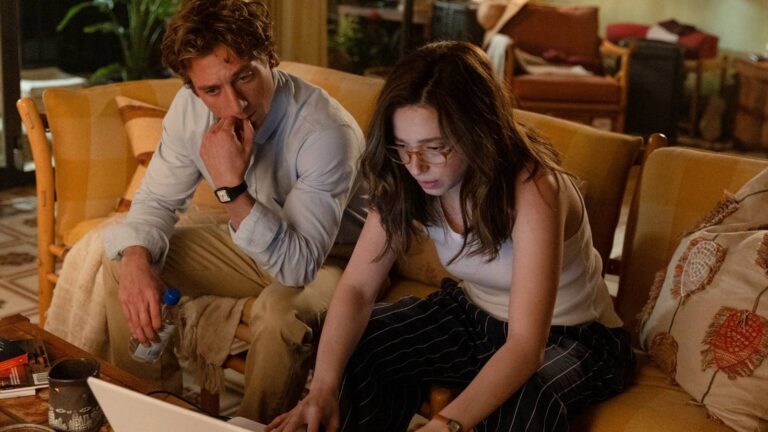
This is the point at which the story splinters into character-driven subplots. We have Justine Gandy (Julia Garner), who taught the now infamous third grade glass. The parents of the missing children, understandably panicked and desperate, believe she’s either entirely responsible for or somehow complicit in the disappearances. Their distrust of her could be warranted; she has a history of inappropriate, boundary-crossing behavior around children, to say nothing of the fact that she’s an alcoholic who has fallen off the wagon. She has an unhealthy on-again/off-again relationship with a cop (Alden Ehrenreich), not only an alcoholic himself but deeply troubled, to the extent that I’d be uncomfortable in his presence were he real.
We also have Archer (Josh Brolin), the father of one of the missing children. To the detriment of his marriage and career as a contractor, he obsessively takes it on himself to solve the mystery of his son’s disappearance, not only out of guilt but also frustration over a slow-moving police investigation that seems to be going nowhere. He firmly believes that Justine knows more than she’s letting on and intends to get some answers out of her. But then there’s … a disturbing incident at a gas station convenience store that forces him to reassess the situation. There’s also an unspoken connection, both having had nightmares about some kind of clown-faced monster. He eventually shares information with Justine, which he was able to gather through a combination of sleuthing and some construction know-how.
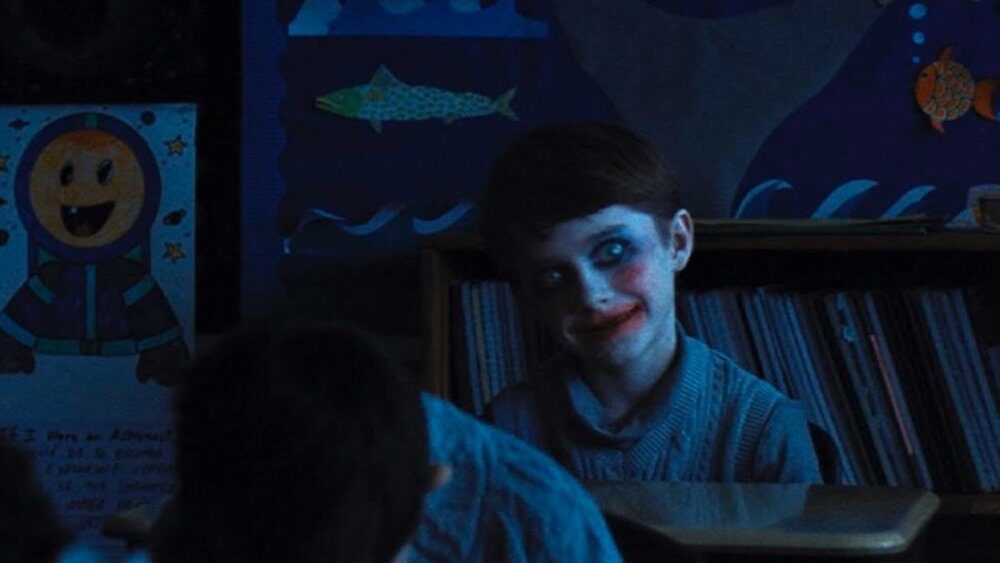
And then there’s Alex (Cary Christopher), the only one of Justine’s students to not disappear. Unfortunately, his subplot is such that I can say almost nothing about it. I’ll pose some teasing questions instead – which, I now realize, is itself a kind of spoiler. Why wasn’t he compelled to leave his home? Why are the windows to his house covered with newspaper? Why has he become so withdrawn at school? Where are his parents in all this? Why does he forcefully tell Justine to stop following him when she begins crossing boundaries again? Rest assured, every one of the above questions is answered. Whether or not you’ll be happy with the answers is another matter. Chances are, if you know the horror genre, you’ll find the explanations appropriate but not necessarily surprising. Such is the problem with any narrative reliant on formulas.
For every question that got answered, I was bothered by one Cregger didn’t think to ask: What purpose do the missing children ultimately serve? The logistics of what made them disappear are clear enough, but the same can’t be said of the reason they disappeared. There’s a vague notion in the form of some cryptic dialogue, but a notion is all it is; the rest is pure speculation on the part of the audience, made possible by the way … certain kinds of horror movie characters are typically depicted. It’s a depiction, incidentally, that’s both overused and unflattering. Why is there almost never a positive representation of these characters, especially in a horror movie, where it’s most needed?
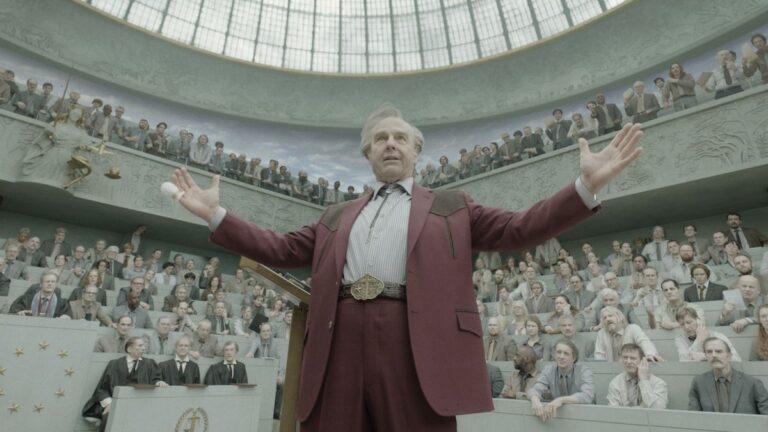
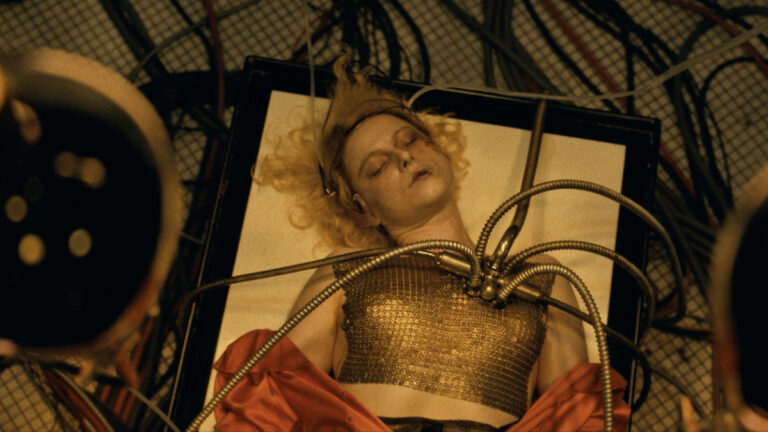
Enough with my opaque wording. Regardless of some narrative flaws – the unneeded subplots that bloat the film’s running time, the occasionally wild tonal shifts between horror and comedy – Weapons is an overall solid film. From jump scares to disgusting gore (especially during the final scenes), it has everything horror fans could possibly want. The genre is such that certain devices are expected, and therefore not as scary as they probably should be. Fortunately, the film isn’t devoid of surprises. The biggest of all was the casting of Amy Madigan, for whom the word “unrecognizable” isn’t enough to describe her physical transformation. No, I will not elaborate. You will have to discover that one on your own.