Caught Stealing is a comedic crime caper about an everyday person unwittingly embroiled in a situation that only grows more violent and deadly with every passing scene. But this is not the newest film from the Coen Brothers. It’s from Darren Aronofsky, and as such, it has just a bit more depth to it. It’s not only about the dark humor, the clever and intricate plotting, or the willingness to depict shocking acts of violence; it’s a metaphorical narrative, the escalating events standing for trauma, unresolved guilt, owning up to past mistakes, and making the choice to move forward. Screenwriter Charlie Huston has adapted his own novel, and while I haven’t read it, I think it’s safe to assume that he remained faithful to himself – at least as far as the story’s overt symbolism, which has been ingrained in literature from the very start.
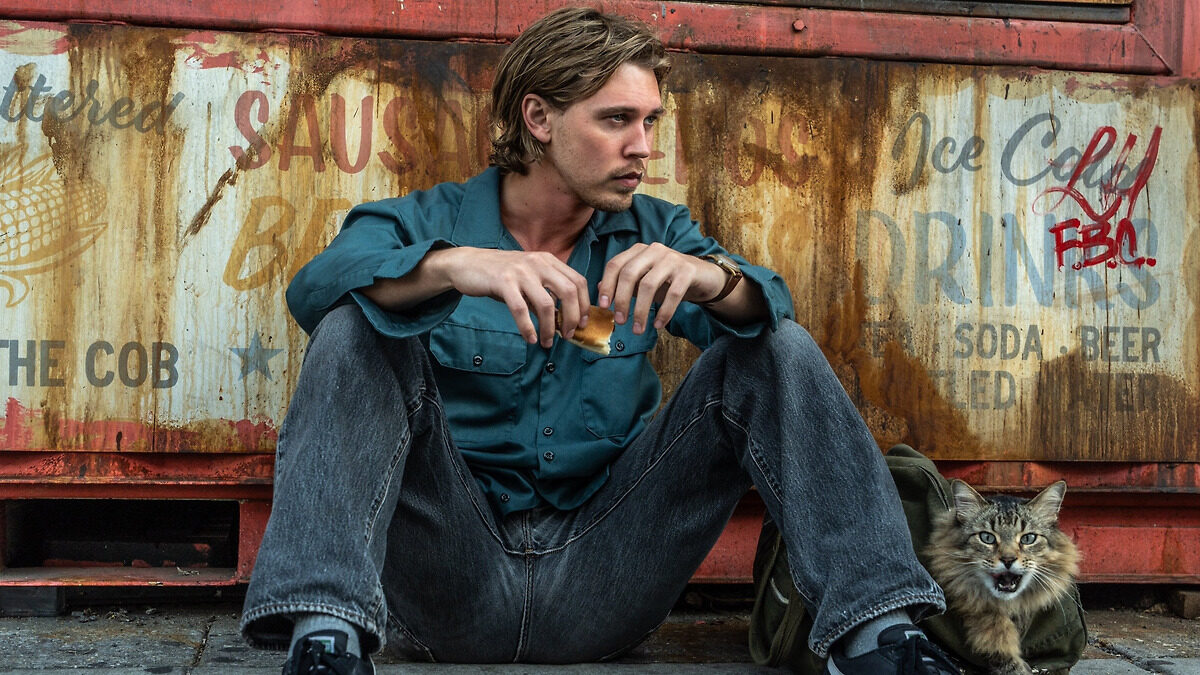
It takes place in Manhattan’s Lower East Side in 1998, before gentrification simultaneously saved it from its ugly grafitti-covered urban decay and robbed it of its rich working-class immigrant culture. In this economically deprived yet ethnically rich world, we meet California-born bartender Hank Thompson (Austin Butler), who in his high school days had a promising future as a professional baseball player but lost it all due to poor judgment. He wasn’t the only one who paid the price for his bad decisions. Despite strong community ties and a potentially good long-term relationship with girlfriend Yvonne (Zoë Kravitz), he’s plagued by nightmares of his stupid mistake and is teetering towards alcoholism.
His world is turned upside down when his neighbor Russ (Matt Smith), a middle-aged English punk who hasn’t outgrown the Mohawk-and-spiked-leather look of the early 1980s, returns to London on account of his ailing father. Aside from leaving him in charge of Russ’ cat, Hank learns the hard way that Russ has been involved in some nefarious drug-dealing activities. Right outside his apartment door, with no warning, Hank is badly beaten by two Russian thugs, the more unhinged of whom (Nakita Kukushkin) has a Gorbachev-like birthmark covering the entire right side of his face. In the ensuing days, Hank will also have encounters with a narcotics officer handling Russ’ case (Regina King), a Latino gangster who’s more than willing to let his gun do the talking when his own verbal attempts fail (Bad Bunny, under his given name Benito Martínez Ocasio), and ruthless Hasidic brothers (Liev Schreiber and Vincent D’Onofrio) who, like stereotypical Italian mafiosos, place just as much importance on family and tradition as they do on execution-style murders.
Much like the Coen Brothers – along with, to a lesser extent, filmmakers like Martin McDonagh, his brother John Michael, and Guy Ritchie – Aronofsky infuses the film with a great deal of dark humor. I was especially amused by a recurring gag of another one of Hank’s neighbors, played with a hilarious mixture of New York toughness and innocent timidity by George Abud, opening his door and complaining about the noise at the exact moments any of the bad guys are there creating chaos. There’s also a Scorsese-esque scene where, under their constant watch and threats of violence, the Hasids, who are ironically anything but godly men, take Hank to the home of their bubbe (Carol Kane) during Shabbat. Loving enough to take in anyone, including goys, she will happily feed Hank with a warm bowl of homemade matzoh ball soup. This is not at all unlike Joe Pesci’s mother in Goodfellas, who happily makes a hearty Italian dinner for her son and his friends while a dying man lies beaten and bleeding in the trunk of Ray Liotta’s car.
But there’s heart underneath the humor, and Aronofsky isn’t afraid to let it show. The situation Hank currently finds himself in represents the trauma he hasn’t yet faced and has been burying, not just with alcohol but a cross-country move; after years of running away from his problems, he may finally work up the courage to own up to his mistakes and face his bad decisions head on. Factoring into this potential redemption is his beloved mother, with whom he communicates with regularly. She instilled in him not just a love of baseball but also a devotion to the San Francisco Giants. For the most part, we only hear her voice on Hank’s answering machine (Google what that is if you’re under the age of thirty); we see her in person only once, and no, I will not reveal the actor that plays her.
Everyone in the film gives a noteworthy performance, but the standout is Butler. Although he has been in show business since he was a teenager, working with the likes of Miley Cirus and Ashley Tisdale, it has only been through recent releases like Elvis and Dune: Part Two that audiences have seen the range he’s capable of. With Caught Stealing, he shows how in control he is of each scene; the film runs an atmospheric gambit between comedy and drama, and he adapts to the changes with a professionalism that almost seems effortless. In one moment, he’s charming, wisecracking, and doing his best to hide his pain behind sarcasm and self-deprecation. In the next, he’s a desperate, vulnerable man forced to think on his feet. What will Butler surprise us with next? Or Aronofsky, now that we know he can handle a crime comedy?