Having directed four films in the Hunger Games series, it’s safe to say that Francis Lawrence understands stories about exploitative survival contests set against the backdrop of dystopian societies. He expands on this very cinematic expertise in The Long Walk, an adaptation of Stephen King’s novel, originally published under his Richard Bachman pseudonym. This is a dark, violent, and ultimately pessimistic story in which Lawrence doesn’t have to restrain himself in order to appease a studio looking to cash in on tween and teenage demographics. Although they will hardly be inundated with them, audiences will not be spared the sight of some grisly and disgusting images. And four-letter words are spoken so freely and often, it’s as if the actors were paid by the letter.
The novel and film have more in common with stories of war than with the ghastly tales of horror King is still most known for. The aim is to horrify audiences the same way they were horrified by films like All Quiet on the Western Front, Saving Private Ryan, and 1917, in which violence and gore are not only par for the course but intended to be repulsive and devastating rather than fun. It can also be argued that the story is more relevant now than it was when first published in 1979; while the United States hasn’t yet stooped to human bloodsport televised for mass entertainment, once sacrosanct democratic ideals are eroding, and we inch closer to fascism with every passing day. Take another look at our increasingly militarized police forces, the demonizing and unconstitutional deportations of working immigrants, and the growing suppression of history and literature, and then tell me with a straight face that I’m wrong.
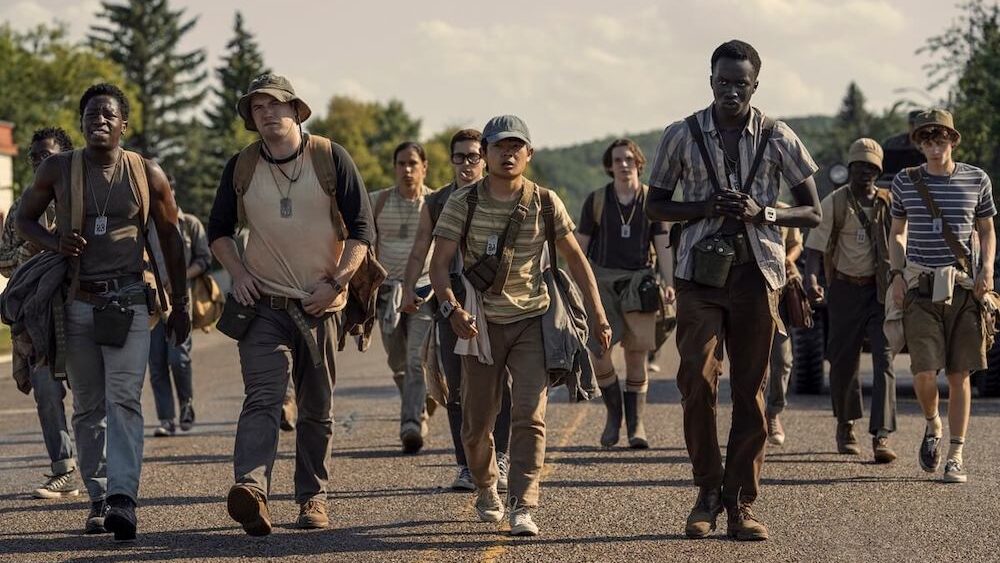
The plot is founded on the idea that, after a major war transformed the United States into an economically ruined totalitarian state, one young man from each of the fifty states is chosen to take part in an annual walking competition where there’s no finish line and the winner is the one who’s left alive. The rules are simple and extremely strict: (1) You cannot walk below three miles per hour; (2) you cannot deviate from the paved road; (3) if you’re not back on track and up to speed after three warnings, you’re shot dead by the military men following along in a Jeep. Food and water rations are provided, but you’re granted no bathroom breaks or sleep. If you engage in either activity, the former shown graphically but not gratuitously, it’s up to you to figure out how to do it at three miles an hour. The winner is rewarded with a cash prize and a granted special request, or wish.
The story’s compelling factor isn’t the violence or the bloodshed, even though it is depicted realistically and without the need to make it thrilling or entertaining. It’s the humanity revealed in the midst of the violence and bloodshed. Some of it is beautiful, like the camaraderie between lead protagonists Raymond Garraty (Cooper Hoffman) and Peter McVries (David Jonsson); theirs is a friendship not at all unlike those depicted between soldiers in war movies, where it’s just as much about finding common ground and sharing personal secrets as it is about maintaining sanity. Also common to soldier characters is a tragic fatalism, an underlying knowledge that not everyone comes home in times of war. Garraty and DeVries also share this, and it’s made all the more unbearable by the fact that there can only be one winner in this walk.
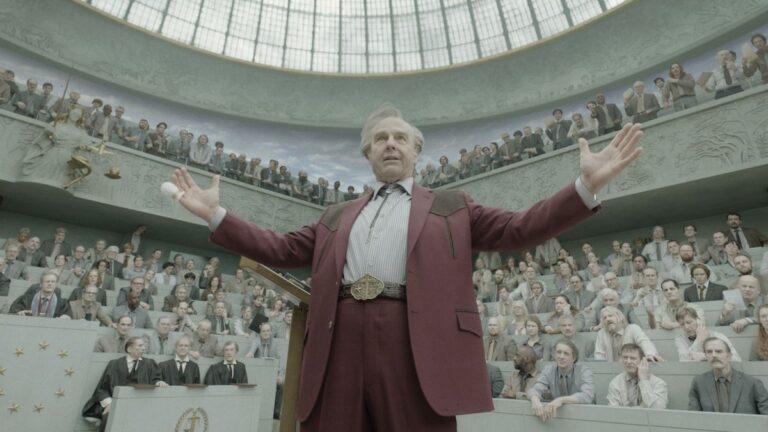
We also see the ugly side of humanity. Some of it is apparent on the dour faces of the destitute citizens the boys pass on the rural stretches of the walk. Some of it is seen in cruel actions that are anything but sportsmanlike. One of the boys, who presumably has a history of antisocial behavior (Charlie Plummer), seems to get off on provoking his competitors. Whether or not he can handle or even comprehend the consequences of his actions is something you will have to discover for yourselves. The ugliest parts are personified by an elderly soldier known only as The Major (Mark Hamill), the gravel-voiced embodiment of toxic masculinity and iron-fisted leadership. Here is a Stephen King antagonist that doesn’t need to be a ghost or demon or monster in order to be terrifying.
But there I go, making this sound like a horror movie. Even with horrific elements, The Long Walk is at its core a multilayered tragedy. On a political level, it’s tragic that the United States fell after a war and succumbed to authoritarianism. On a human level, it’s tragic that the population must rely on a deadly game for financial security – which, when vied for by forty-nine other people, is a longshot at best. When personal ideology becomes punishable by death, well, that’s the biggest tragedy of all. More so than in 1979, this story holds a mirror up to American culture and reveals an ugly, distorted reflection. Similarly to certain science fiction films, it’s also a frightening premonition of where we may be heading. We have the ability to change. The jury is still out on whether or not we have the desire.
About The Author