Of the two film adaptations of Warren Alder’s novel The War of the Roses, Jay Roach’s The Roses is definitely the better one. It works to its advantage that it’s even less faithful to its source than Danny DeVito’s 1989 film; Alder’s tragic satire of wealthy excess at the dawn of the Reagan era is outdated, and Americans have by and large become so numb to the reality of wealth gaps that they aren’t as likely to feel their narrative stings. This is probably why Roach and screenwriter Tony McNamara avoided satire altogether and instead focused on relationships and marriage. I grant you that these topics are far more general and hardly new to the movies. It’s more about how the story is told than the story itself.
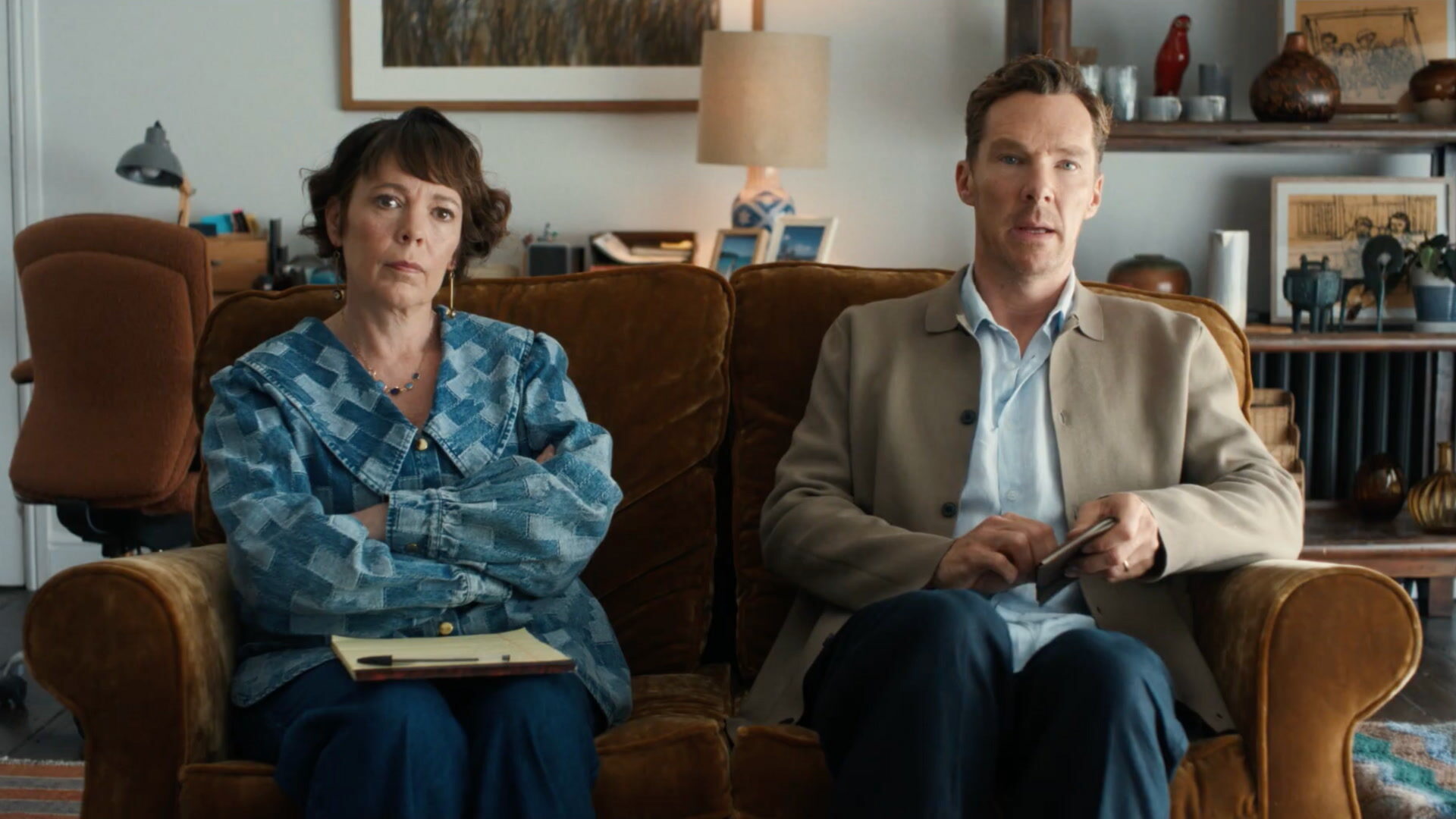
DeVito’s film was critically acclaimed. I for one was put off by his darkly comedic approach. The title characters, played by Michael Douglas and Kathleen Turner, morally devolved when ownership of their Washington, D.C. mansion became a bone of contention in their divorce; as far as I was concerned, there was nothing inherently funny about their falling out of love or their increasingly deplorable behavior towards each other. Roach’s film, though still dark, earns the right to be funny. That’s because the title characters, now played by Benedict Cumberbatch and Olivia Coleman, aren’t depicted as loving one minute and hateful the next; they have had a sarcastic and acerbic love language since day one, but they haven’t yet learned that a successful marriage depends on looking past any resentments, jealousies, and pet peeves.
Unlike the book or the first film, The Roses sees the title characters, English expats living in Mendocino, California, as full flesh-and-blood human beings. Both have strengths and weaknesses. More importantly, both have legitimate and ridiculous reasons for wanting to divorce. The cracks begin to show when husband Theo (Cumberbatch), an architect, loses his job and all professional credibility after the spectacular collapse of his latest building. Although this affords him the time and opportunity to remold his children (Delaney Quinn and Ollie Robinson) into health-conscious athletes, it also strips him of his identity. So bruised is his ego that he can’t help but deeply envy his wife Ivy (Coleman), who’s on a meteoric rise as a chef. But as is always the case, success takes her away from her children, who were initially used to her less disciplined, more indulgent style of parenting.
Things get worse several years later, when Ivy’s money allows Theo to bypass reclimbing the corporate ladder and go straight to designing and building a new family home. By then, their teenage children (Hala Finley and Wells Rapaport) have earned early athletic scholarships and are already leaving home. So while Theo gets his confidence boost, Ivy suddenly feels her children’s absence. On the one hand, she blames herself for putting her career ahead of her family. On the other hand, she blames Theo for turning the children into people she never thought they were, and thus feels he robbed her of them. They finally reach their breaking point and start divorce proceedings. This is where the film is the most faithful to the book; Ivy and Theo, each stubbornly claiming a right to the house, go to increasingly extreme lengths to drive each other out. It’s childish at first, then diabolical, then dangerous.
I’m not making this sound like a comedy. Believe me when I say that it thrives on dark humor. But unlike DeVito’s film, which forced comedy into unfunny situations, we’re able to laugh because the story has an emotional core, one that’s authentic and, in some respects, relatable. This isn’t about two mismatched people bringing the worst out of each other; it’s about soulmates who haven’t yet figured out that successful marriages require some messy and unpleasant compromises. Theo and Ivy could learn a thing or two from their married friends, the darkly philosophical real-estate lawyer Barry (Andy Samberg) and the very handsy and desperately sex-starved Amy (Kate McKinnon); although they have the same resentment issues as Theo and Ivy, they have clearly put work into pushing through them, simply because they know they were made for each other.
The film’s best scene is, sadly, the only one to feature Allison Janney. She was all too perfectly cast as Ivy’s high-powered divorce attorney, and she shows her authority not only with her emotional-support Rottweiler but also with her command of the sentence, “Don’t talk.” And what are we to make of the ending? Unlike The War of the Roses, in which DeVito led the audience to an outcome so inevitable as to be anticlimactic, Roach opted for bitter irony with The Roses. It was the only appropriate narrative approach, given not just what we know about the title characters but also what the story is trying to tell us. This isn’t a cautionary tale of wealth and materialism. It’s a rumination on long-term relationships and what it takes to make them work.