Tim Burton's The Nightmare Before Christmas
1993
Tim Burton’s The Nightmare Before Christmas is the most imaginative and enchanting holiday musical film to come along in many a moon. It’s also one of the year’s most technically impressive, the story brought to life via stop-motion animation, a process so painstaking that it’s no wonder it’s almost always reserved for either brief special effects scenes or hour-long TV specials. The work that went into this film doesn’t go unappreciated. Indeed, you truly are a dedicated animator when you have to pose your clay figures twenty-four times to achieve just one second of finished film. Given the movie’s length of seventy-nine minutes, that’s nothing to sneeze at. Directors of such projects require the same level of patience; the director of Nightmare, Henry Selick, probably now qualifies for sainthood.
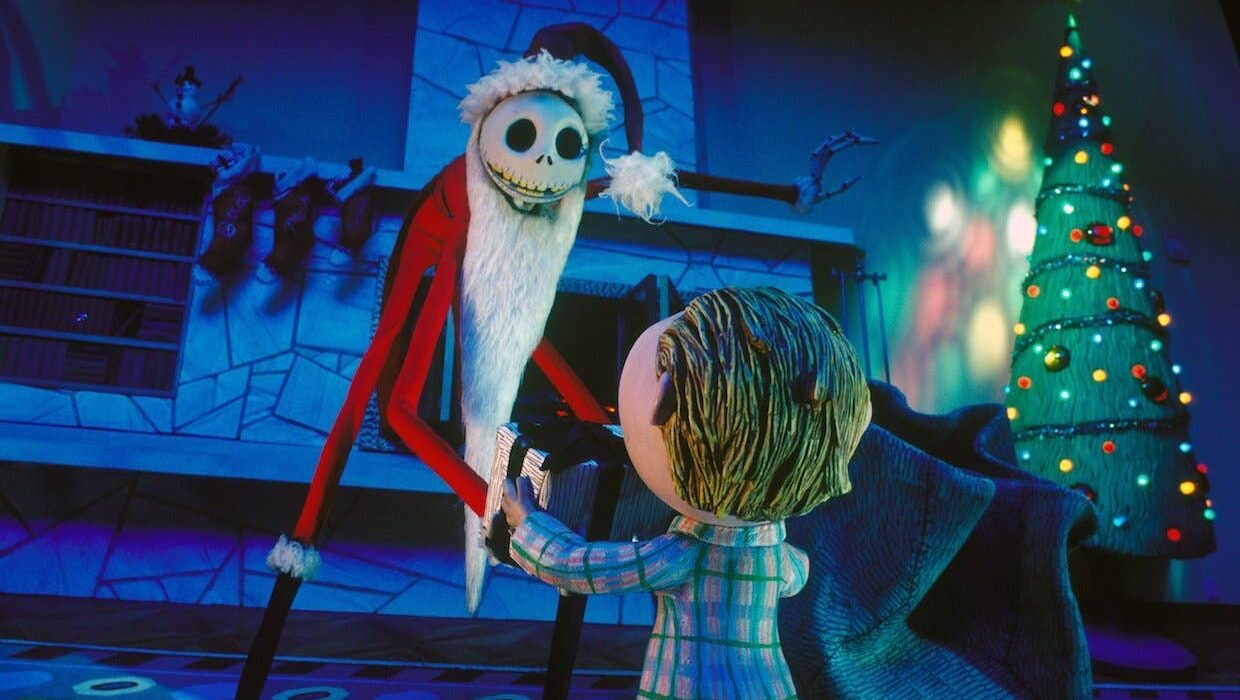
Conceived and co-produced by Tim Burton, the plot is founded on the idea that all of the major Western holidays have their own worlds, each accessible through doorways carved into a ring of trees deep in a fantasy forest. In Halloween Town – a gothic, shadowy, quasi-German Expressionist land populated by all manner of zombies, witches, vampires, and monsters – the King of Halloween, the spindly skeleton man Jack Skellington (speaking voice by Chris Sarandon, singing voice by the film’s composer and lyricist Danny Elfman), has grown despondent over how routine and dull his once-favorite holiday has become. He literally falls into Christmas Town, which I guess is the new name for the North Pole, and is so taken by its bright Seussian cheerfulness that he decides to become Santa Claus and take the holiday over, at least for this one year.
This isn’t an evil scheme on Jack’s part. It’s a sincere but misguided effort to fill the emotional void in his bones. While the citizens of Halloween Town are on board (most have been recruited by Jack to do various decorating and toy-making tasks), one person has serious doubts, galvanized by a vision of impending doom. This would be Sally (voiced by Catherine O’Hara), a beautiful, wise, and reasonable take on Frankenstein’s Monster, her paper-white skin stitched together to hold in a stuffing of leaves. Restless, willful, and well stocked with sleep-inducing poisons, she repeatedly escapes from the laboratory of her creator, a possessive wheelchair-bound mad scientist (voiced by William Hickey) with a flip-top skull cap that allows him to literally pick his brain. Sally clearly has feelings for Jack, although he’s too obsessed with Christmas to be anything more than friendly to her.
Meanwhile, a trio of mischievous young trick-or-treaters (voiced by O’Hara, Elfman, and Paul Reubens) kidnap Santa (voiced by Ed Ivory) at Jack’s behest. But rather than see to Santa’s comfort, as they were asked to do, they maliciously hand him over to Oogie Boogie (voiced by Ken Page), an evil, hulking burlap monster whose lair is a UV-bathed cross between a casino and a torture chamber. Apart from the fact that he’s the designated bad guy, no reason is given for why Oogie Boogie wants to imprison and presumably inflict pain on Santa Claus – or, as the naive citizens of Halloween call him, Sandy Claws. If Christmas is to be saved – not just from Oogie Boogie but also from the well-intentioned Jack, who doesn’t realize his presents are too scary and dangerous for children – Santa needs someone to come to his rescue.
Musically, the songs by Elfman continue to demonstrate his mastery of dark, memorable melodies, mostly heard in the quirky films of Tim Burton. Lyrically, there’s room for improvement; while some of his words are suitable in the context of the scenes and the characters they involve, others are so amateurish that he has little hope of being mentioned in the same sentence as the late Howard Ashman or the Sherman brothers. As for the instrumental score, it’s at its best in a sequence of Jack, dressed as Santa and driving a coffin-shaped sleigh led by skeleton reindeer, delivering presents to the children of suburbia. You hear a near perfect blend of fantasy, action, whimsy, and just a touch of horror. The suburban scenes, incidentally, shows that Selick not only watched Edward Scissorhands but committed to memory Burton’s depiction of middle-class tract housing, from the bland colors to the neat isometric angles to the retro Christmas decorations, both inside and out.
The film’s PG rating, due to some of the scarier images, has led to concern over how appropriate it is for children. Parents are obviously the best judges of these things, but I truly believe Tim Burton’s The Nightmare Before Christmas is not only appropriate but something children will greatly enjoy. I would argue that the film isn’t too scary. It’s just scary enough. And if you think about children’s entertainment that has withstood the test of time – Lewis Carroll’s Alice books, L. Frank Baum’s Oz books, The Adventures of Pinocchio, the works of Roald Dahl, and the many fairy tales that have been countlessly retold, especially since the days of the Brothers Grimm – they all have a certain degree of creepiness. The title notwithstanding, the film is not a nightmare at all, but a delightful dream, a real feast for the eyes and ears.

 C. R. Pandolfi