Edward Scissorhands bypassed the roadblocks of my logical brain and found its way directly to my heart. This is a resoundingly beautiful movie, a visually splendid and emotionally rich fable that successfully reinterprets classic themes like acceptance, intolerance, friendship, and loneliness. Director Tim Burton, whose previous films relied on odd visuals to evoke a sense of fun, now uses them to demonstrate the differences between people and what they value. The title character is a series of contradictions, stylistically underscoring the complexity of everyday individuals. On the outside, he’s almost ghoulish, but on the inside, he’s warm and tender. Because of his hands, which are actually sharp sheers of metal, he can destroy just as easily as he can create. He’s expressive, and yet he has trouble communicating, both verbally and physically.
The Edward character, played by Johnny Depp, is basically a reworked version of Frankenstein’s Monster. He’s the creation of an inventor who lived alone in a gothic mansion high atop a hill. Unfortunately, this inventor (Vincent Price) was very old, and he died before Edward received his hands. Thus, Edward was left alone in the mansion, with nothing but the hedges outside as an outlet for his creativity. One day, Avon Lady and housewife Peg Boggs (Dianne Wiest) drops by, hoping to make a sale. Frightened by his appearance yet saddened by his solitude, she decides to take Edward home with her. Home, in this case, is a typical middle-class suburb of cookie-cutter architecture, pastel colored houses, neatly manicured lawns, and neighbors who love to gossip. Edward is excited by his new surroundings, but more to the point, the neighbors are excited by Edward; within no time at all, he makes a name for himself as a hedge artist, a barber, a dog groomer, and an ice sculptor. He even gets to flaunt his paper-cutting techniques at a school’s Show and Tell day.
He appeals to the suburbanites, and yet it would be too much to say that they become his friends. To them, he’s a novelty act, a distraction from the humdrum lives they lead on a daily basis. They use him only when they want something done, undoubtedly as a way to make themselves look trendy. Keeping up with the Joneses, you might say. Even Peg, who shows Edward nothing but kindness, looks to him if she needs a thread snipped, or a haircut, or a face to test her new cosmetics on. For fickle-minded consumers, novelties quickly become tiresome. What happens when they completely wear out? Usually they’re forgotten, but in some cases they’re attacked, especially if they’re misinterpreted as an overhaul of the status quo.
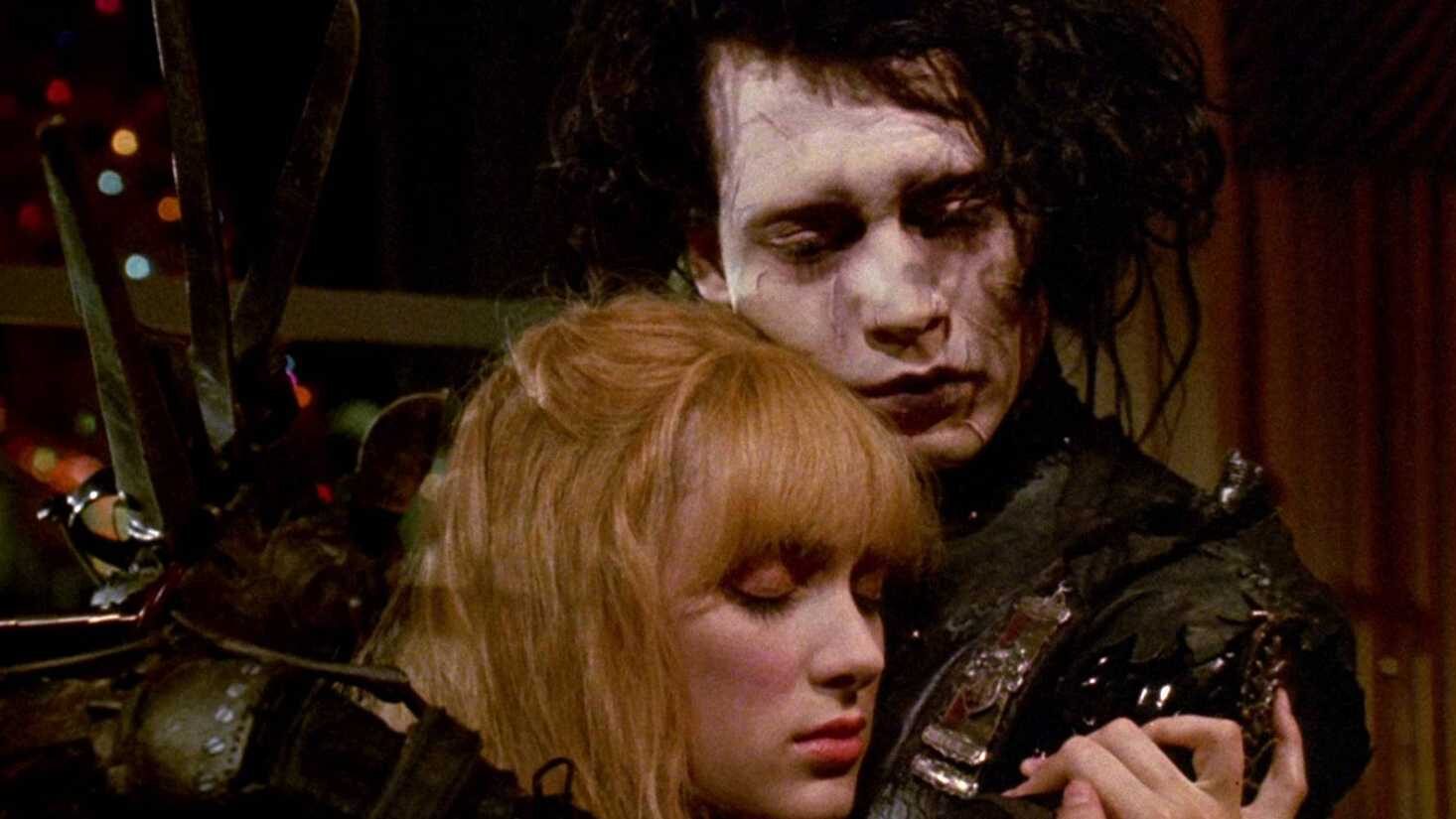
Peg’s teenage daughter Kim (Winona Ryder), who initially resists Edward’s presence, comes to sympathize with him. She might even be on her way to loving him, much to the chagrin of her boyfriend Jim (Anthony Michael Hall), outwardly the epitome of the young male suburbanite but within a seething monster – jealous, domineering, and ultimately dangerous. “Hold me,” Kim tearfully pleads to Edward during one of the film’s most touching scenes, where she finally realizes he’s everything Jim isn’t and can never be. Edward’s reply is brief but heartbreakingly honest, to himself more so than to her.
This movie triumphs on levels other than its story. Despite being filmed in live action, despite the use of physical sets, the film takes on a heightened, almost magical visual quality, as if each frame were a picture out of a storybook. Even the suburbs seem a little too bland to be completely real. This is good because Edward Scissorhands is, in fact, a story within a story – a fairy tale bookended by segments of an old woman telling a story to her young granddaughter. Watching this movie, there’s always the sense that the world does not exist outside the scope of the camera’s lens. We’re being shown exactly what needs to be shown, and no more. The result is haunting yet magnetic, a blend of plain isometric angles and freeform gothic whimsy.
Depp’s performance is striking, relying more on pantomime than on dialogue. Indeed, Edward would have been a fine character for a silent film, were it not for the appearance of his pale, scarred face and bizarre hands. In the tradition of the pre-talkie movie stars, his eyes convey every possible emotion to the audience, from curiosity to fear to anger, and yes, to sadness. To understand this character, one need not be intimately familiar with horror or German expressionism or the gothic subculture. One only needs to remember what it was like to be awkward and misunderstood. If you can’t relate to this, welcome to the Human Race.
It isn’t often I come across a film that seems to be speaking to me directly. Edward is a bizarre creation, and yet he’s one of the most relatable characters I’ve ever come across. The scenery is otherworldly, and yet there’s the sense of feeling right at home – even amongst the macabre architecture of Edward’s mansion. Burton has three times before proven himself a master of kooky visual splendor, but only now has he allowed himself to fully and earnestly tell a story. Edward Scissorhands is not a film for the mind; like music, it plays directly on the emotions, and more often than not, it strikes chords so beautiful that they reverberate in your soul long after they have gone silent.
About The Author