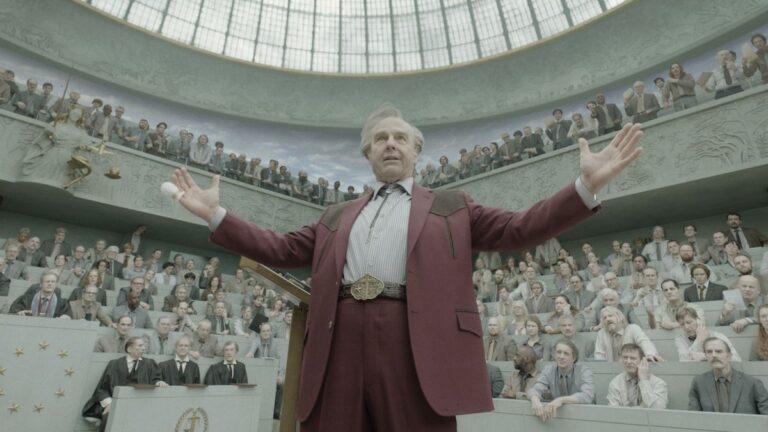
When screenwriter Aaron Sorkin broached the subject of Facebook in David Fincher’s 2010 masterpiece The Social Network, it was purely about the creation of the site; never once did it examine the potential ramifications of social media usage or predict just how ubiquitous it would become, how it would affect the mental health of populations the world over. Of course, such predictions would have amounted to little more than speculation. But now with The Social Reckoning, for which Sorkin acts as both writer and director, no speculation is required. It’s based entirely on years of gathered facts and figures – damning facts and figures brought to light through dogged journalism and courageous whistleblowing. Given the numerous social media addiction lawsuits, to say nothing of how vast our political divides have grown, I’d say it’s the right film at the right time.
It’s also one of the best films of 2026. It’s every bit the equal of The Social Network, not in terms of its subjects but in the meticulous, compelling, often entertaining, and occasionally thrilling ways its subjects are examined. In the specific case of The Social Reckoning, it has the added value of scarily accurate social commentary: While the tech bros of the world have implemented algorithms to politically manipulate people, people often want to be manipulated, whether subconsciously or not, because it’s only in raging echo chambers that they feel validated. The latter point is more implied than directly stated, but given what we’re shown, how it’s told to us, and what we know of the real world, it’s impossible to not make that correlation.
As is the case with just about anything written by Aaron Sorkin, the film awashes the audience with first-rate dialogue. A lot of it is data- and computer-centric technobabble everyday people wouldn’t understand. I had no problem with this approach; much like The Front Page, its remake His Girl Friday, All the President’s Men, and Saturday Night – and yes, The Social Network – the point isn’t for us to comprehend the incomprehensible, but to immerse us in a world that only a select few can access. However, Sorkin does lend a helping hand with his dramatized version of Wall Street Journal investigative reporter Jeff Horwitz (Jeremy Allen White), a quasi-Luddite who needs all the tech words explained to him. He’s not just the man behind a series of Pulitzer Prize-winning reports that came to be known as The Facebook Files; he’s the layperson that most everyone in the audience is.
Horwitz, in the film and in real life, would never have had a story were it not for Facebook data scientist Frances Haugen, the whistleblower who not only discovered the algorithms designed to enrage already radicalized hate groups but also leaked thousands of the company’s internal documents. She’s played by Oscar winner Mikey Madison, and she may have secured herself another nomination. Her performance is a prime example of a scared individual caught in a moral quandary. A socially awkward nerd whose celiac disease requires the constant wearing of wrist and leg warmers, part of her believes in Facebook, in how beneficial it can be for non-people persons. Reconciling that with what she discovers, including the complicity of those at the top, becomes increasingly difficult, as one would expect.
This leads me to Facebook CEO Mark Zuckerberg, seen almost entirely during practice runs of an impending Senate hearing. When played by Jesse Eisenberg as a college student in The Social Network, he was the main character, and his myopic vision of success was second only to his less than charming personality. He’s now played as an adult by Jeremy Strong, and while no longer the main character, he’s just as key as the story’s villain. In both the movie and real life, he refused to implement safeguards against false information, the promotion of violence, and the sharing of harmful content, despite knowing the negative impact it would have – not the least of which was the attempted Capitol insurrection on January 6, 2021. He of course takes no responsibility, citing his absolutist position on free speech. I’m more inclined to believe he needed the Facebook radicals; they could influence voters towards politicians less inclined to implement social media regulations.
Much like Eisenberg in 2010, Strong may also get noticed by the Academy for his performance. He masterfully runs the gamut of Zuckerberg’s personality quirks. In the space of a single sentence, he can go from condescending to arrogant to petulant, all while maintaining cold, detached facial expressions. My greatest hope is that Sorkin himself will pull off another Oscar win. He’s one of the few living screenwriters who makes listening to a movie just as big an event as watching one. His way with words is on par with Rodin’s way with clay, or Michelangelo’s way with marble, or Mozart’s way with music. The Social Reckoning keeps this reputation alive. It also brilliantly dramatizes a true story, made all the more important by celebrating a free and fair press, encouraging positive ethics, and recognizing the accomplishments of respectable whistleblowers.