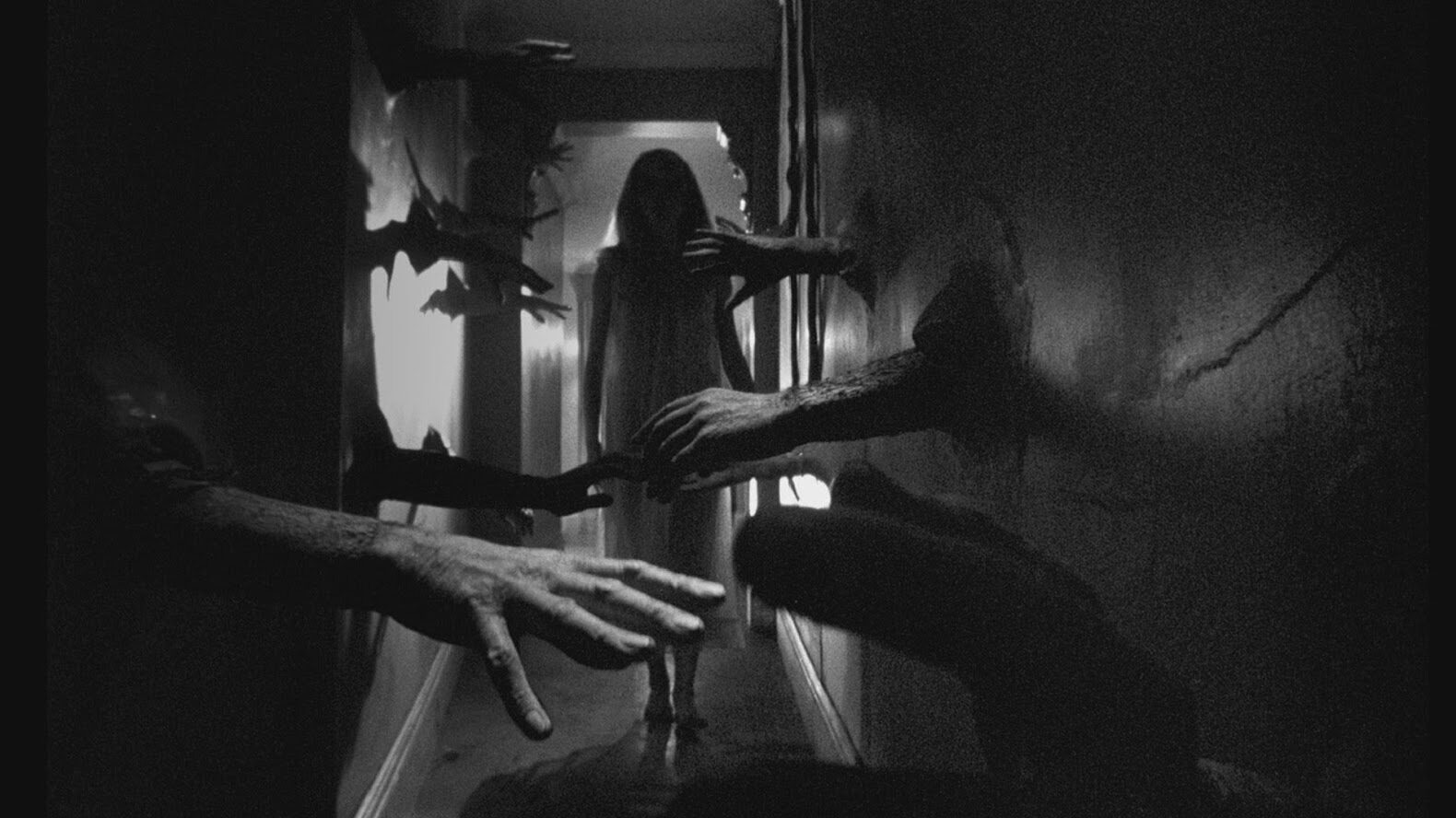
The great thing about a psychological thriller, especially when it depicts a character descending into madness, is that it forces you into really watching it. There’s more at stake than merely the mechanics of mental deterioration; we’re challenged to piece together an explanation from a combination of vague biographical hints, current environmental conditions, and the continuous presence of visual symbolism. Repulsion is a film that works very much along those lines. It’s a disturbing portrait of a young woman who has reached her breaking point. The trick is determining what brought her to this state. Never once do the filmmakers offer an obvious reason. The best we get are subtle hints and a plethora of suggestive images, many of which are shown so repeatedly that they obviously represent a motif.
The young woman is a Belgian named Carole (Catherine Deneuve), who works in a London beauty salon as a manicurist. She’s the epitome of European beauty – flowing blonde hair, fair skin, a perfectly proportioned face – yet her eyes continuously betray a battered and tormented soul within. Indeed, the first shot is an extreme close up of her right eye nervously moving about, as if desperately scanning the periphery of the screen. She doesn’t say very much, and her mind wanders quite easily, leaving her staring off into space. What we immediately notice is that she’s especially uncomfortable around men. In spite of this, she has attracted the attention of a young man named Colin (John Fraser), who repeatedly fails at winning her affections. He is perhaps too forthright on two occasions, one in which he tries to kiss her and another in which he breaks down her door. And yet, there is the persistent if indistinct notion that he truly is in love with her.
What’s especially fascinating is the way director Roman Polanski depicts men and women. We know these depictions can’t all be derived from Carole’s point of view, as certain scenes play without her being present. There’s a very intentional division of thoughts and behaviors. Colin frequents a pub with two obnoxious friends who make no bones about objectifying women. Much later, Carole will have an encounter with her landlord, who initially comes off as merely cantankerous but soon after reveals that he only has one thing on his mind. On the flip side, Carole will listen to her female coworkers and clients, some having a thing or two to say about the men in their lives. One is discovered in the cellar crying; her hopes that her new boyfriend was different from all the others have been dashed. Another is an older woman who claims to know exactly how men think and insist that they should all be treated as objects to be toyed with.
Carole lives in an apartment with her sister Helen (Yvonne Furneaux), who’s having an affair with a married man named Michael (Ian Hendry), who’s not especially mean spirited but could certainly use some polishing. Carole doesn’t like him one bit. She can’t stand the fact that he frequently stays over and leaves his razor and toothbrush in her designated glass in the bathroom. Helen and Michael go to Italy on vacation, but even before then, we see that Carole is on the verge of a breakdown. At first, we’re shown small physical compulsions, including nail biting, lip chewing, body scratching, and the act of brushing or dusting off with her hand, even though there’s nothing to dust away. As the film progresses, we’re shown overt hallucinations, including a wall made of clay, hands that emerge from the walls and grab at her, and a man that repeatedly breaks into her bedroom and rapes her. Most prominently, cracks will appear and disappear in all the walls of the apartment.
Polanski intercuts the more intense scenes with moments that rely on unsettling subtleties. The phone will frequently ring, and many times, there’s no one on the other end. In Carole’s bedroom, we’re very much made aware of the sound of a ticking clock. And then there’s the persistent imagery of food in declining stages of freshness. A loaf of bread goes stale. Potatoes shrivel up and sprout. A skinned rabbit, originally intended to be cooked by Helen, is taken out of the refrigerator and left to rot on a pile of books. The camera pans over to it on multiple occasions, as if to reinforce the notion that it serves as one of many metaphors for the condition of Carole’s mind. Her apartment and everything it contains are falling apart. Despite this, it’s apparent that she’s unable or unwilling to leave it.
The situation will escalate even further when Colin reenters Carole’s life, and of that, I will say no more. How did it come to this? We’re certainly given plenty to think about in terms of what Carole is surrounded by. Consider the fact that she would lie in bed and endure the sounds of her sister and her boyfriend having sex in the other room. Across the street from the apartment is a Catholic school; apart from the sounds of the children playing at recess and the pealing of the bells, we see the occasional nun, a physical manifestation of Carole’s repression. Most importantly, there’s a family portrait, which remains mostly in the background until the final shot, in which the camera comes in real close and reveals that only two of the subjects are bathed in light. If we had any suspicions during the vast majority of Repulsion, this is the point at which they’re shown to be correct.
About The Author