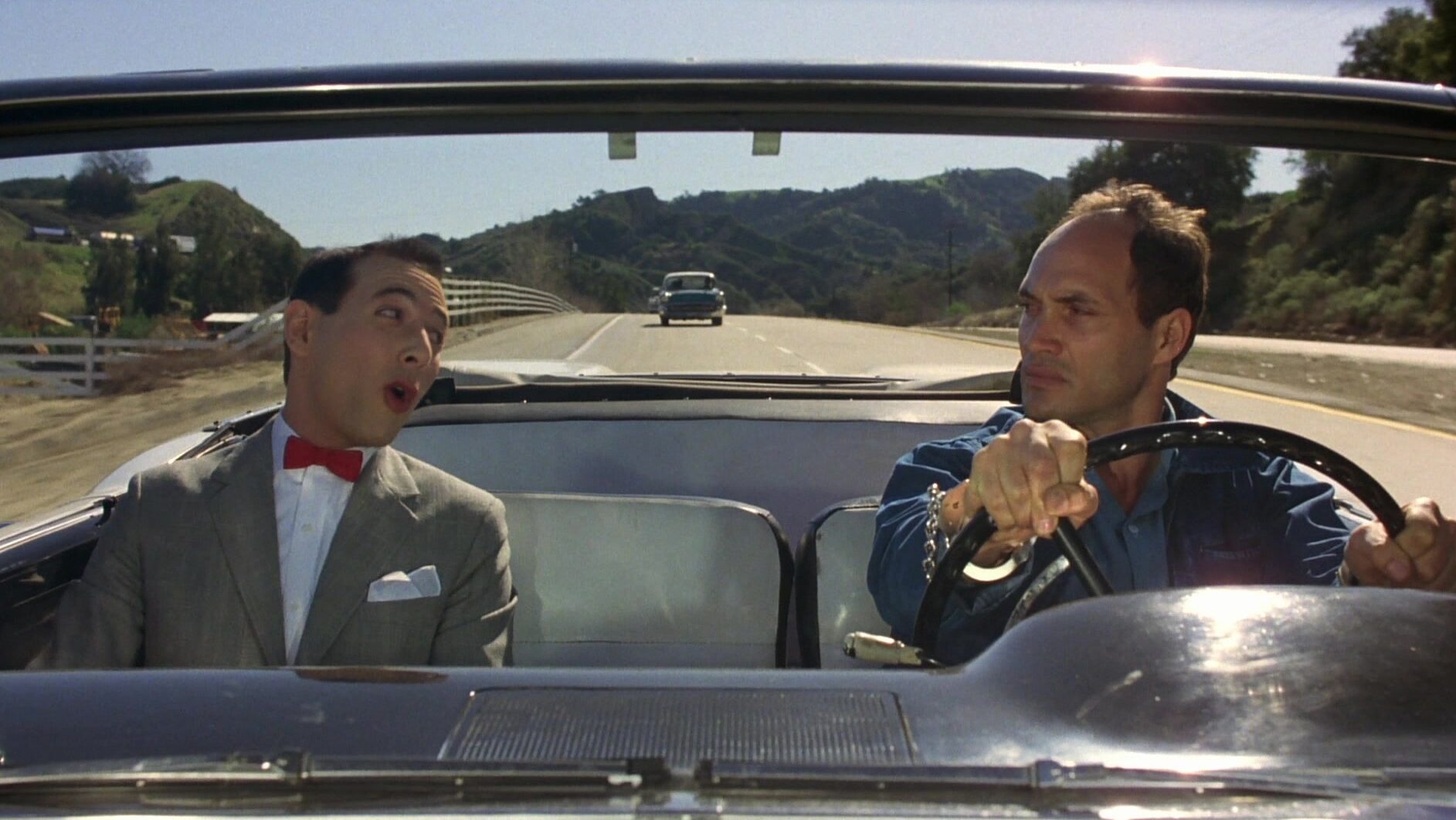
I don’t think we’ve ever seen a character like Pee-wee Herman before. Played by comedian Paul Reubens, he has the body of an adult man but the mind and imagination of a child. He’s not mentally challenged so much as immature – the boy who never grew up, so to speak. He’s generally innocent, although he can be bratty. His voice is goofy. He laughs like a hyperactive clown, a trait that actually downplays the ridiculousness of his gray glen-plaid suit and red bowtie. He likes to play games, and his home is a cross between a clubhouse and a toy store, with trucks, action figures, and train sets cluttering his bedroom. There’s also a whimsically elaborate machine in his kitchen that makes breakfast. Although he lives alone and has no apparent family or means of support, he does have friends, and they seem to regard him with the same loving curiosity people have for newborn puppies.
He’s a curiosity, all right. But what Pee-wee’s Big Adventure so cleverly demonstrates is that the people outside Pee-wee’s community are even more of a curiosity than he is. In the course of the story, he meets a singing hobo, a scam artist posing as a fortune teller, a perky tour guide, a jealous brute of a boyfriend, the ghost of an elderly truck driver, and an escaped convict whose worst crime was cutting off the Do Not Remove Under Penalty of Law tag from a mattress. He even finds himself in a lowdown desert bar filled with satanic bikers, one of whom is easily recognizable as Cassandra Peterson, better known as Elvira. What is the message here? That the outside world is just as strange, if not stranger, than the one we come from?
The MacGuffin of the story is Pee-wee’s beloved Schwinn bicycle, which has been stolen. His journey to get it back takes him from his Anytown, USA home to the Alamo and ultimately to Hollywood, where it seems a movie can be made out of just about anything. He meets a number of people along the way and has a positive influence on most of them – and this includes, perhaps not surprisingly, the satanic bikers. All the while, he tries to avoid a puppy-love romance with a bike shop employee named Dottie (Elizabeth Daily), a genuinely charming young woman. Pee-wee’s preschool attitude towards the opposite sex is actually kind of cute, as is his excuse for not wanting to do something as innocent as spend an evening with Dottie at the drive-in: “I’m a loner, Dottie. A rebel.”
In spite of the realistic settings, the film is essentially a live action cartoon – narrow in plot, broad in character, silly in its approach to action, and visually preposterous. It’s goofy in a delightfully juvenile way, as if it were representing the way a child perceives the world. Indeed, the world can be a very strange place; sometimes it’s joyful and funny, but sometimes it’s also quite scary, and in the end, we just want to go home and play with our toys. Some will look at this movie and think director Tim Burton, making his feature film debut, didn’t create so much as regress, his imagination having been stunted at age ten. I look at it and see a fairly accurate portrayal of a child’s viewpoint, and I give Burton credit for remembering what that’s like.
Some of this is reserved for dream sequences, where Pee-wee fears the worst for his bike. A combination of claymation, oversized props, bizarre characters, and minimalist sets that hint at German Expressionism, they perfectly capture the idea that young imaginations have a tendency to be overactive. But even “reality” has its adolescent eccentricities. Consider the antagonist Francis (Mark Holton), who’s just as much of a manchild as the title character; at a certain point, we find him in an indoor swimming pool pretending he’s a sea monster. Also consider a scene in which Pee-wee drives a car in the middle of the night; he passes three road signs, each with a more impossibly twisted arrow on it than the last. He ends up driving off a cliff, but never fear; the textile roof of the convertible he’s driving doubles as a parachute.
The penultimate sequence, which takes place on the lot of Warner Bros. Studios, is amusingly stereotypical, virtually every situation founded on idealized notions of Hollywood. This definitely includes a studio executive whose personality is defined solely by making deals, clipping his fingernails during meetings, and calling everyone “babe.” It must be strange meeting someone like this when you’re only a child. Or at the very least, when you’re someone who looks like an adult but acts like a child (Reubens, in actuality, was in his early thirties during principal photography). It’s difficult to imagine more “mature” audiences getting anything out of this movie. For whatever it’s worth, I found Pee-wee’s Big Adventure oddly endearing, not only because of the quirky visuals and the antics of the title character, but also because of the story’s naive point of view. It seems I’m childish myself.
About The Author