Ebenezer
2026
Ebenezer is arguably the only adaptation of Charles Dickens’ A Christmas Carol that would have been better suited for a Halloween release. This is the darkest, scariest film version of the story to date, beating out Robert Zemeckis’ motion-capture version in the weight of its mature themes and the ghoulish nature of the visuals. Even though it follows the basic line of the book’s plot, and in spite of its final act – now known to everyone thanks to the many, many film and TV adaptations – it’s really more of a horror movie than a holiday perennial. No wonder; the director and co-editor is Ti West, known almost exclusively for his contributions to the horror genre. In this version, the Ghosts of Christmas Past and Present are just as terrifying as Yet to Come, ghosts look more like decayed zombies, and portentous crows emerge disgustingly from otherworldly mouths.
I’m not saying that the film is bad. If anything, it’s a superb technical achievement, a triumph of performance, and sometimes even better than Dickens at character development. Nor am I saying that the original book is free of terrifying moments. Between Jacob Marley’s postmortem visit to Ebenezer Scrooge and the entire Ghost of Christmas Yet to Come sequence, with its frightening visions and somber warnings, there’s a reason Dickens himself called it a “Ghostly little book” and prefaced it by saying, “May it haunt their house pleasantly, and no one wish to lay it.” West and screenwriter Nathaniel Halpern apparently took those words to heart. The film is likely to haunt a lot of people’s houses, although I have my doubts it will happen pleasantly.
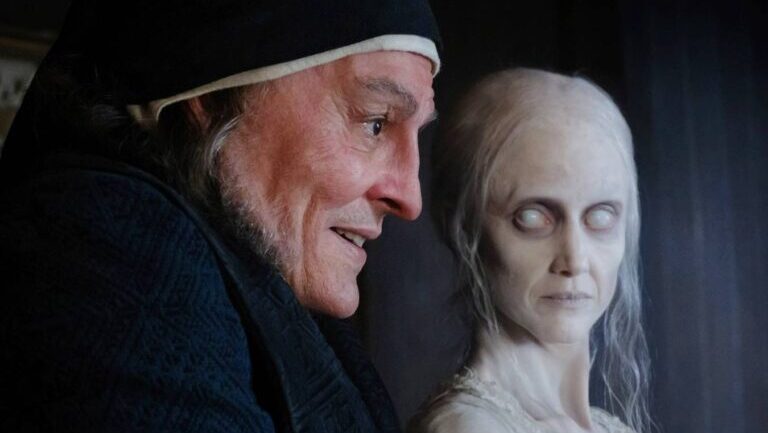
Consider the fact that the film opens with us witnessing Marley’s death, and that, on his magical journey to redemption, Scrooge is almost always haunted by moaning ghosts with marbled, corpse-like skin. Christmas Past, described in the book as a delicate and brilliant elfin wraith, is here more like the bride from Disney’s Haunted Mansion, her flowing dress tattered, her bony skin pallid, her eyes concealed beneath ghastly cataracts. Christmas Present is not a jolly Father Christmas type so much as a short-tempered glutton, and his brief life on Earth isn’t depicted as natural aging but as a rapidly spreading skin disease. Just wait until he reveals what’s under his robes. Christmas Yet to Come has always been a mute death figure in the vein of the Grim Reaper; here, West takes it a step further by making it a full-blown demonic entity. And of course it’s introduced in an ossuary under a church.
Some additions aren’t supernatural but are terrifying nonetheless. Old Fezziwig, for example, met with a dark fate, one that contributed to Scrooge’s miserly ways. And Scrooge’s childhood was marred by more than isolation at a boarding school; he was bullied by the other boys, and upon returning home, he was physically abused by an alcoholic father. Perhaps this was nothing more than piling on the drama. On the other hand, we have a Scrooge that’s more fleshed out. We also get deeper insight into Scrooge’s underpaid clerk Bob Cratchit. While still meek and conciliatory in front of Scrooge, he’s prouder at home, and is clearly frustrated by his inability to get his crippled son Tiny Tim proper medical care. He also isn’t blindly grateful simply for being employed. Needless to say, he doesn’t propose a toast to Scrooge in this version of the story.
I haven’t wasted time with a plot description, since we all know what the story is about. But I have to address the film’s most important performance. Johnny Depp, returning to mainstream acting after years of legal and financial setbacks, was perfectly cast as the title character. Aside from nailing Scrooge’s physicality – the nose that comes to a slight point, the back slightly bent with old age, the deep wrinkles, the thinning gray mutton chops, the near permanent scowl – he expertly captures Scrooge’s emotional gamut. At times, Depp is as broad and theatrical as Seymour Hicks and Reginald Owen were in the 1930s. At others, he’s subtler, more human, able to shed believable tears for Scrooge’s more introspective moments.
I’m in no way trying to diminish the contributions of the other actors. Rupert Grint is nothing short of compelling as a wearier, less hopeful Bob Cratchit. Ian McKellen exudes a scornful pity as the deeply wizened Jacob Marley, both in life and as a chained ghost. Andrea Riseborough draws from all the best ghost-movie cliches as the Ghost of Christmas Past, while Tramell Tillman is more intent to scare Scrooge straight than enlighten him as the Ghost of Christmas Present. Although Sam Claflin’s take on Scrooge’s nephew Fred is slightly less cheerful and optimistic, he doesn’t lose sight of Fred’s ability to hope. The most surprising performance came from Sara Galvin; in an expanded character arc, she plays the elderly version of Scrooge’s lost love Belle with such empathy that I couldn’t help but be touched.
I’ll end this review with a brief analysis of the dialogue. Most film versions of A Christmas Carol stayed true to Dickens’ words, almost as if they came from a Shakespeare play. Although Ebenezer does use several of the book’s most famous lines, the dialogue as a whole isn’t weighed down by Dickens’ more stilted nineteenth-century prose. It’s not dumbed down so much as modernized – more direct and clearer to the average twenty-first-century ear. It can be argued that the film’s darker than usual tone factored into this artistic decision. When I see a back-alley stabbing or corpse hands emerging from the fetid dirt of a graveyard, I’m not as inclined to respond to lines like, “Dreadful apparition, why do you trouble me?” or, “There’s more of gravy than of grave about you, whatever you are!” Thankfully, the story’s most famous quote, “God bless us, everyone,” was kept. Removing it would have been the scariest thing of all.

 C. R. Pandolfi