I don’t know what I was expecting from The Wizard of Speed and Time, but it certainly wasn’t a mile-a-minute whirlwind of comedy, parody, and imagination that kept a big, dopey grin on my face from start to finish. If ever there was a movie that could be described as the real deal, this would be it. It’s a semi-autobiographical film about a filmmaker, made by a filmmaker who is clearly head-over-heels in love with filmmaking – the art and the craft. Virtually every scene is an explosion of creativity and sheer exuberance. When I say “creativity,” I mean it in the truest sense of the word; despite a production schedule of over five years on a reported shoestring budget of $1.5 million, writer, director, co-producer, special effects creator, editor, and star Mike Jittlov cleverly made the most of what little he had to work with. This is the work of a man unencumbered, a real auteur.
In a similar vein to films like Singin’ in the Rain and Silent Movie, it’s also a lighthearted Hollywood satire filled with slapstick, fast-paced action, brutal zingers, and a jaundiced view of the business side of moviemaking. Indeed, Jittlov takes no prisoners when it comes to producers, investors, and even the good people of the IRS. However, he doesn’t stoop to lowbrow, gory fantasies of having them killed, maimed, or tortured. That would be too easy – and, frankly, too good for them. He instead turns them into living cartoon characters, buffoons intentionally painted in broad strokes so that we may figuratively destroy them with laughter. In this heightened, goofy context – where lines of dialogue are silly, where accents are amateurish, where performances are theatrical – it’s more than acceptable for the enemies to be one-note caricatures. I think it’s a requirement.
No doubt that Jittlov, an unabashedly independent filmmaker, is cynical about the Hollywood studio system. He certainly depicts it as such: A bureaucratic hellscape of excessive regulations, unscrupulous money men, demanding egos, and endless catch 22s. One especially funny sequence seems inspired by a trip to the DMV; Jittlov, desperate for credentials, zooms from one union office to another, only to be told by every clerk (played at various levels of put-on by William Z. Ryan) that he can’t join unless he meets requirements that are impossible to meet without already being in a union. In spite of this, Jittlov doesn’t wallow in acrimonious misgivings. On the contrary; his is a film of unbridled joy, a gleeful celebration of total creative freedom.
The plot sees a dramatized version of Jittlov, an unknown and cash-strapped but passionate special effects creator, on a resourceful mad dash to complete the visuals needed for a TV special about special effects. He was hired as part of a $25,000 bet between the director and producer of rival studios. The director (Steve Brodie) sees potential in Jittlov after reading his script, which of course was saved from a huge pile of unread scripts destined for the trash. The producer (Richard Kaye, ironically one of the film’s producers) is an underhanded miser who plots to have Jittlov kidnapped by inept thugs (Frank LaLoggia and Gary Schwartz). Helping Jittlov trudge through his underfunded and time-crunched project is an aspiring actress (Paige Moore), who appreciates his unfettered artistic drive, and his loyal cameraman friend (Deven Chierighino, another producer).
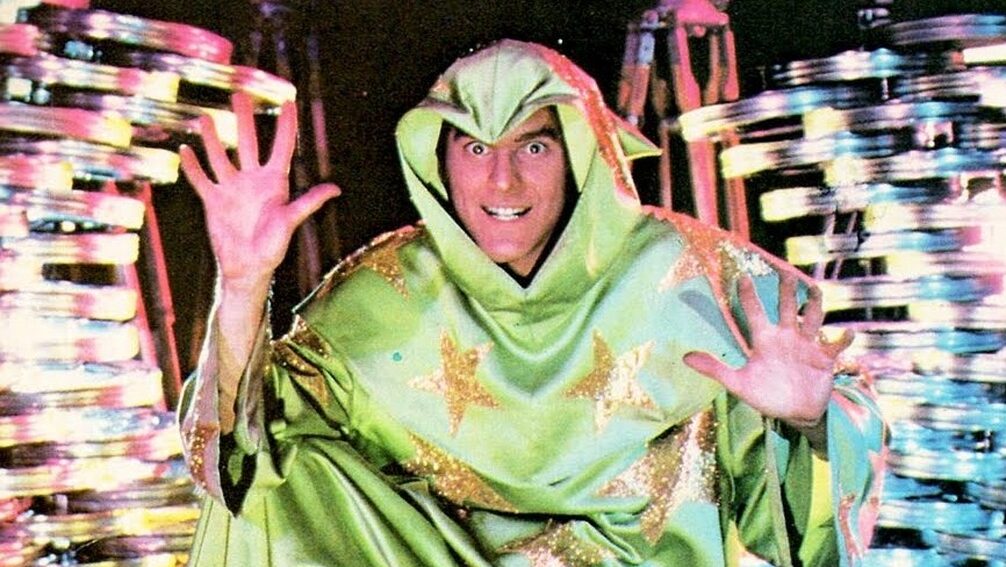
Jittlov, always in either a jacket or cloak of lime green, shoots all this with tremendous energy and enthusiasm. He often puts his own person through the wringer in the same way as a professional stuntman; in the course of this film, he will sprint cross country at Road Runner speeds, be chased down the streets of Hollywood riding a suitcase car of his own invention, and defy the laws of nature by magically passing through walls and producing business cards in quick flashes of light. He achieves this imagery through a common but effective combination of stop-motion photography, filming at lower frame rates, optical printing techniques, and good old fashioned fearlessness. How metafictional that his methodology is also used by his cinematic self, whose studio in his mother’s house is a playful shrine of real-world filmmaking tools and fantastical gizmos constantly in motion.
Unlike the independent sci-fi/horror films of Harold P. Warren, Ed Wood, and Robert Gaffney, the unpolished nature of The Wizard of Speed and Time – which features excerpts from some of Jettlov’s ‘70s short subjects, including his demo reel of the same title – belies any notion that Jittlov is devoid of talent. Make no mistake, he has talent in spades. It’s just that it’s raw, unfiltered talent, the kind that hasn’t been diluted by studio interference and the commercialistic pursuit of a blockbuster. Mike Jittlov is a true artist, driven not by the lure of fame and fortune but by the commitment to authenticity. His film is proof that you don’t always need the most money, the biggest stars, or the highest profile directors to make something great. Sometimes, all you need is a vision, a natural gift, and a whole lot of determination.