Reviews
The Room
2003
.
R
.
1hr 39m
The Room is not your run of the mill incompetent movie. It’s incompetent at a level not seen since the films of Ed Wood. I wouldn’t be surprised if, fifty years down the line – hell, maybe even ten years, or less – it’s mentioned in the same sentence as Plan 9 from Outer Space. But why limit it to that? It could be mentioned in the same sentence as Santa Claus Conquers the Martians, or The Story of Mankind, or Manos: The Hands of Fate, or any of the dozens of other films featured on Mystery Science Theater 3000. If that show is ever revived, The Room would be a good film to start with. It’s so excruciatingly awful on every conceivable level that its only hope of being remembered is to find a cult audience with very low standards.
The writer, director, producer, and star is Tommy Wiseau, who, like Ed Wood, must have a lot of passion for the art of filmmaking. Unfortunately, also like Ed Wood, passion in no way crosses with talent. He can’t write. He can’t cast. He has no sense of structure, pacing, or character. And my God, he can’t act; setting aside the difficulty his unplaceable foreign accent creates for those that want to understand what he’s saying, he delivers every one of his embarrassingly amateurish lines with the nuance and believability of a college student who took all the drama classes as a way to meet girls. His expression is frozen in a state between half-asleep and drunk. None of this is helped by the fact that most of his lines were very obviously dubbed in post production.
It tells the story of a man named Johnny (Wiseau), whose fiancée Lisa (Juliette Danielle) coldly and inexplicably falls out of love and begins having an affair with Johnny’s best friend Mark (Greg Sestero). On the surface, it sounds like a decent, if unoriginal, idea. Just wait until you see how badly Wiseau messes it up. He populates the film with characters so one-dimensional that you’d swear they’d disappear when turning sideways. Worse still, the characters are played by actors who clearly, obviously, painfully can’t act. I sound as if I’m being nasty, but in fact I’m trying to convey, as one would to a dear friend, that they’re not intended for this line of work and need to pursue something else.
The way the first half of the film is structured, you’d think Wiseau was trying to make an adult film, which actually would have been an improvement; every opportunity for a sex scene is taken, just as every opportunity is taken to flaunt the fact that both Wiseau, with his flowing shoulder-length locks, and Sestero, with his boyish jock physique, look like models on the covers of dime-store romance novels. Strange, that the sex scenes aren’t very sexy. They’re shot at the oddest of angles, they show no real interest in the human form of either gender, and the mood is killed by the use of forgettable ‘90s-style R&B songs as background music. Every cue of Mladen Milicevic’s original score, incidentally, sounds like an electronic demo for a nineteenth-century period film.
The main set, the living room of a San Francisco apartment, has a door that everyone seems to enter and exit at their leisure; on only two or three of those occasions do we hear knocking or the doorbell. Unnamed characters show up late in the game and give their two cents, despite the fact that we haven’t gotten to know them. Subplots are introduced and then altogether forgotten. Take, for example, the scene where Lisa has a conversation with her opinionated mother (Carolyn Minnott); the mother, in her you-should-listen-to-me-because-I-know-best tone of voice, tells Lisa that she’s dying of breast cancer, and Lisa, in her disaffected youth tone of voice, tells her mother that she needs to focus on her health. After this hilariously unconvincing moment has passed, the mother’s cancer is never brought up again, and topics such as chemotherapy, radiation, and hospitalization aren’t once broached.
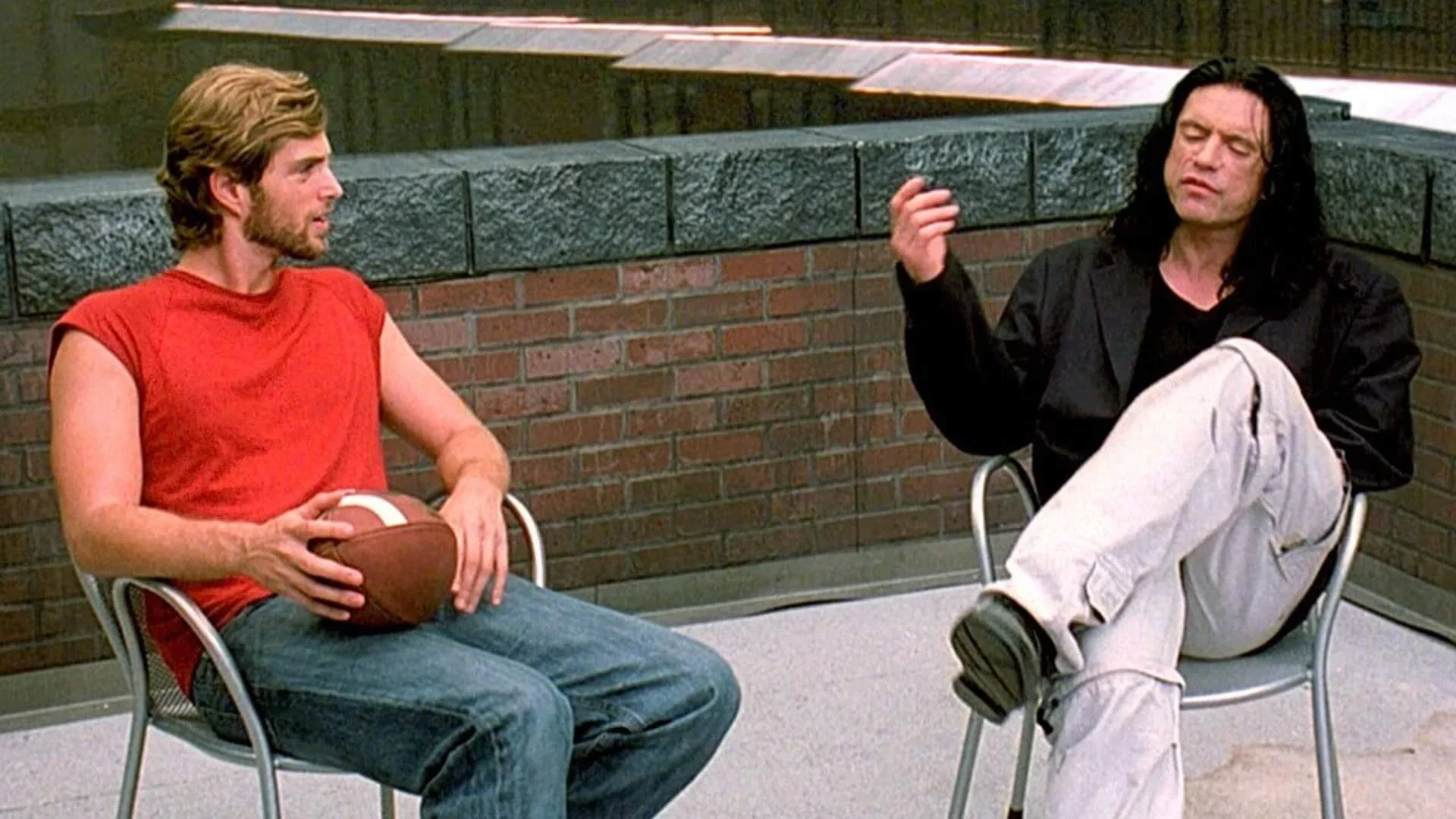
Also take the character of Denny (Philip Haldiman), a fresh-faced teen who Johnny took under his wing financially; without so much as a buildup, Denny is attacked on the roof of the apartment by an armed man demanding payment, and without so much as an explanation, the armed man is subdued by both Johnny and Mark and taken downstairs with amazing ease. Do the police ever come to arrest the armed man? Who knows? Does the fact that Denny began selling drugs ever factor into the story again? Not at all. The relationship between all the male characters, Johnny and Denny included, is a strange one. Only they would toss a football around in tuxedos. Indeed, only they would wear tuxedos a full month before Johnny and Lisa are set to wed.
Movies like this are astounding. They beg so many questions. How could the filmmakers have ever believed they were working on something worthwhile? Why did nobody notice how bad the performances were, how awkward the dialogue was, how thinly the characters were developed, how rife it was with inconsistencies? Who agreed to finance it even after reading the screenplay? Who agreed to distribute it even after seeing the final cut? We film critics are often the target of people who like to say, “You couldn’t have done a better job yourself.” In the case of The Room, I’m confident in my assertion that yes, I could have done a much better job. But I’m not bragging – just about anyone could have done a much better job.


 C. R. Pandolfi