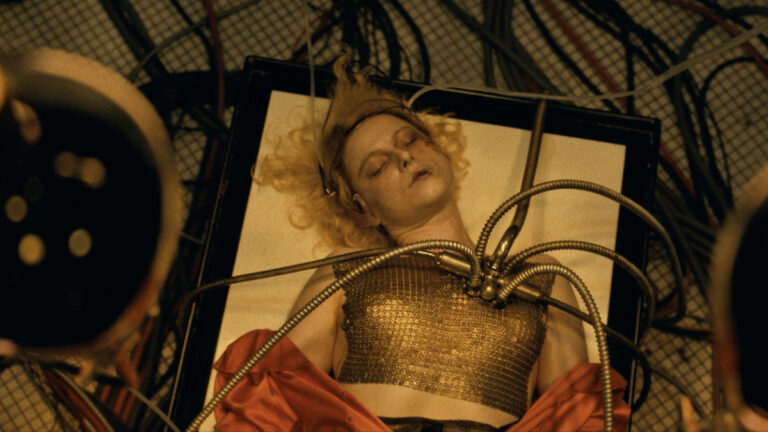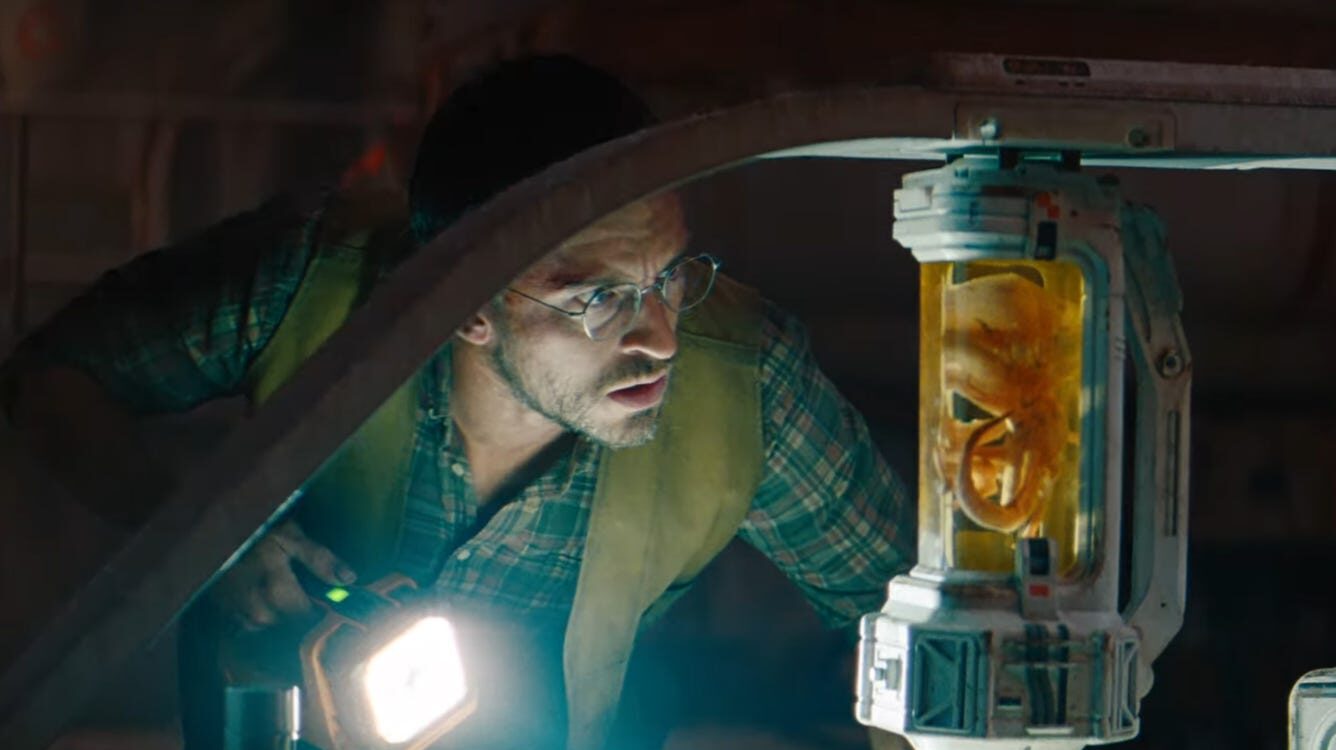
For better or worse, Gareth Edwards is always in his wheelhouse when helming a high concept science fiction action thriller. He finds himself there once again with the 3D Jurassic World Rebirth, a film faithful in spirit to a great many Atomic Age monster movies of the 1950s. This isn’t to suggest that neither Steven Spielberg’s Jurassic Park nor the Michael Crichton novel that inspired it weren’t high concept or thrilling. It’s just that one got the sense, however vaguely, that compelling ethical subtexts and hints of actual science were worked into their respective plots. But we’re now seven films into the franchise, and at this point, it seems no one wants to speculate on true-to-life possibilities anymore, or even bring up the ethics of dinosaur cloning; it’s all about making unadulterated monster movies, solely intended to entertain audiences.
There’s nothing inherently wrong with this approach, if that’s what you started with. But 1993’s Jurassic Park didn’t start that way; the filmmakers wanted to entertain and say something meaningful, however briefly. One can liken it to, as Paul Freeman said in Raiders of the Lost Ark, falling from the purer faith. In this case, that means, among other things, featuring dinosaurs that never existed in real life but were instead genetically spliced by mad scientists. Indeed, the film begins nearly twenty years ago in a lab where dangerous experiments are kept locked in massive key-controlled cages, while the failed mutations, including the two-headed ones, float dead in huge tubes of formaldehyde. An accident at the lab – caused by, of all things, the wrapper of a candy bar – allowed the surviving experiments to escape.
The foundation of the plot, and I swear I’m not making this up, is the creation of a new heart medication. In accordance with the ridiculous logic movies like this are famous for, its pharmacology depends on genetic samples from the three largest remaining species of dinosaurs – one from the land, one from the sea, and one from the air, like branches of the military. Getting these samples will be no easy task; the dinosaurs that spread to all parts of the world in previous films are now dying off due to climate change, and those that remain can only be found on and around equatorial islands off the coast of South America. We’re told that these parts of the world are heavily guarded by various governments, but lest there be no movie at all, of course the lead characters will nautically sneak in as easily as can be, without so much as one patrol boat chasing them or even seen off in the distance.
It should come as no surprise that the top-secret mission to obtain the genetic samples is overseen by the oily executive of a pharmaceutical company (Rupert Friend). His recruits: A covert operations expert (Scarlett Johansson), who masks her past traumas and PTSD with snarkiness; an obsolete paleontologist (Jonathan Bailey), who likes crunching on Altoids and is surprisingly adept at shooting military-grade weapons; and the operation expert’s old friend (Mahershala Ali), an American expat in Suriname who’s appointed team leader. As they sail to the Island of Mutated Dinosaurs, they will be joined by a group of civilians, the victims of a dino-related boat capsizing reminiscent of scenes in the Jaws films: A middle-aged father (Manuel Garcia-Rulfo); his two daughters, one teenaged (Luna Blaise), the other around eight years old (Audrina Miranda); and the teen’s boyfriend (David Iacono), who comes off as lazy and irresponsible but of course will eventually earn the father’s respect.
My misgivings notwithstanding, the film does offer a few good thrills. There’s an especially fun sequence involving an inflatable raft and a T-Rex, even if the latter shouldn’t by its very anatomy be able to swim. One scene in an 7-Eleven-style convenience store, long since abandoned, evokes the kitchen sequence in the original Jurassic Park, this time with a Raptor/Pterodactyl hybrid. Another scene, reminiscent of the air duct chase sequence in Aliens, has the leads running through an underground series of drainage tunnels. My personal favorite was a cliff-scaling scene involving a different hybrid species of Pterodactyl, along with the ruins of an ancient temple and a nest of eggs from which the paleontologist can obtain his genetic sample. I couldn’t help but wonder why he opted for an unhatched egg in this instance; for the other two species – far bigger and, in one case, far more dangerous – he went for drawing direct samples of blood.
The real question is: Will the Johansson character remain a mercenary driven only by the money promised by Big Pharma, or will she grow a conscience and give the samples to an open source, paving the way for a heart medication accessible to all? Strangely enough, I didn’t expect that to be the crux of the story. Jurassic World Rebirth, a misnomer title if ever there was one, has more in common with films like King Kong, Lost Continent, and The Beast from 20,000 Fathoms than it does with the first Jurassic Park, which is to say it’s an escapist B movie above anything else. Will potential audiences care about creating a heart medicine, or a hireling’s moral quandary over it? I have my doubts. I think they will have more fun guessing the characters that will live and die. Of course, these kinds of movies are bound by formulas, so bothering to guess at all is pointless.