Journey Back to Oz is a lightweight, insubstantial, and cloying cartoon musical – not at all what I would have expected from a sequel to The Wizard of Oz. That it boasts an impressive voice cast makes it all the more disappointing, to say nothing of the missed opportunity to seriously adapt any of L. Frank Baum’s thirteen literary sequels to The Wonderful Wizard of Oz. While children – very, very young children – may appreciate the drawings and bright colors, I don’t envision them responding to it as previous generations responded to its predecessor, a middling box office success that became a beloved perennial. So inconsequential is this new film in plot, characterization, and theme that, with about thirty minutes worth of cuts, it could have avoided theaters altogether and been a perfectly nice TV special.
Right off the bat, they could have started by eliminating every one of the songs by Jimmy Van Heusen and Sammy Cahn. To say that they’re generic would be paying the songwriters a compliment; every melody and lyric is so bland, so completely lacking in both style and substance, that they evaporated from my memory before they could finish. The Wizard of Oz gave us “Somewhere Over the Rainbow,” “Ding-Dong! The Witch Is Dead,” “Follow the Yellow Brick Road/You’re Off to See the Wizard,” and “If I Only Had a Brian,” just to name a few, and I defy you to tell me you weren’t pleased to have them stuck in your head ever since your very first viewing. No one is likely to leave Journey Back to Oz humming their favorite tune – or any tune, for that matter. They may also not appreciate the fact that songs are essentially second-rate, non-copyright-infringing knockoffs of those from the first film.
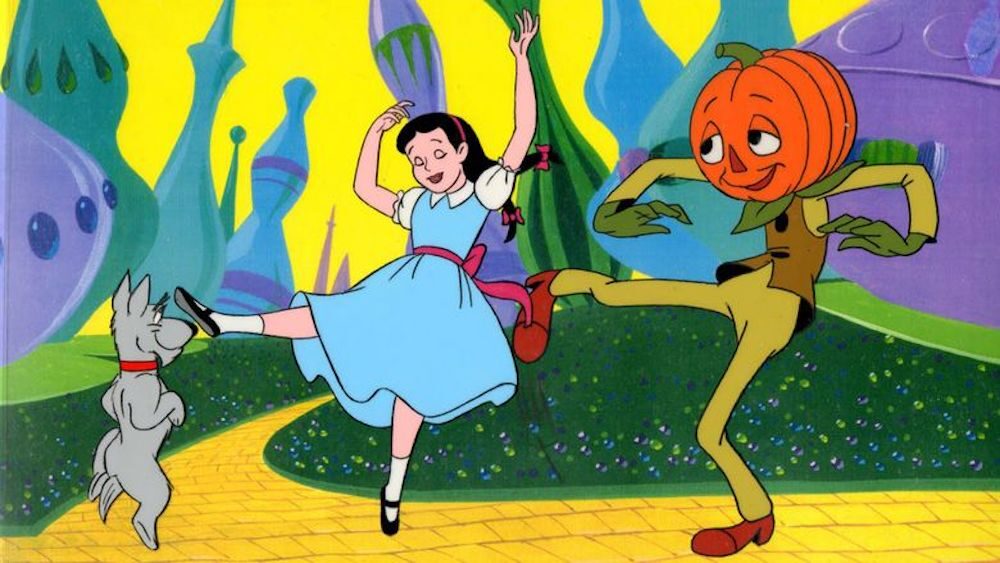
The plot: After another tornado transports her to the land of Oz, which looks more like the abstract paintings of Mary Blair than the whimsical sets of the 1939 film, Dorothy Gale must rescue her old pal Scarecrow, now the King of the Emerald City, from the clutches of Mombi, the evil cousin of the melted Wicked Witch of the West. She has created an army of green elephants and uses them in her scheme to steal Scarecrow’s crown and rule all of Oz. If Dorothy is to stop her, she must seek out her other old pals Tin Man and Cowardly Lion, both of whom now regret receiving their respective gifts of a heart and courage for reasons not made clear, not even in song. She gets far better help from two new characters, one a wobbly pumpkin-headed man created by Mombi to be her servant, the other a pink wooden horse that has never landed a successful job and dreams of being part of Scarecrow’s royal cavalry.
I did like the voice cast, some of whom have direct connections to The Wizard of Oz. Dorothy, for example, is voiced by Liza Minnelli, whose mother Judy Garland played the same role in 1939. Garland’s friend and frequent co-star Mickey Rooney voices Scarecrow, and Margaret Hamilton, who famously played the Wicked Witch of the West, now voices Dorothy’s Aunt Em. As for the rest of the cast, my favorites were Paul Lynde as the perpetually anxious Pumpkinhead and Ethel Merman as the thoroughly wicked Mombi. Herschel Bernardi had just the right mix of toughness and heart as the wooden horse. I was pleasantly surprised by Milton Berle as the Cowardly Lion, even if the character’s screen time is all too brief. I was initially unsure if he could capture the vaudevillian goofiness of Bert Lahr in The Wizard of Oz; not only did Berle capture it, he successfully made it his own.
Unfortunately, good voice casting can’t make up for subpar animation. Director Hal Sutherland doesn’t aim for art, like the animated films of Disney, but rather assembly-line shortcuts like the cartoon TV shows of Hannah-Barbera. Dorothy was drawn with the same basic facial expressions all throughout, which conveys nothing in the way of nuance. She was also given only three or four arm poses, all stereotypically girlish, and in general looks like a mass-marketed paper dress-up doll. Mombi, described in the Oz books as a clever shapeshifter, is here no different from any of the generically designed cartoon witches we always see around Halloween, be they in TV specials, family movies, or even on cheaply made plastic masks sold in drugstores. The best we get is her transforming herself into a rose, as she did in Baum’s The Marvelous Land of Oz.
The animation in general has a rushed, simplistic quality one would expect from television rather than film. Aside from the limited quality of the character designs, almost no effort is put into basic subtleties like shading. Why should a character hiding behind a bush or inside a dark room look just as fully colored as if standing in direct sunlight? Even in direct sunlight, wouldn’t there still be shading differences on the neck, under the arms, and on the legs? At the very least, couldn’t the characters have cast shadows? Between this, the uninspired story, the forgettable songs, and the hackneyed theme of having faith in yourself – provided by the good witch Glinda (voiced by Rise Stevens), who’s now less of a sage and more of a discount version of the Fairy Godmother – Journey Back to Oz proves that sometimes, thirty-five years isn’t enough time to wait for a sequel.