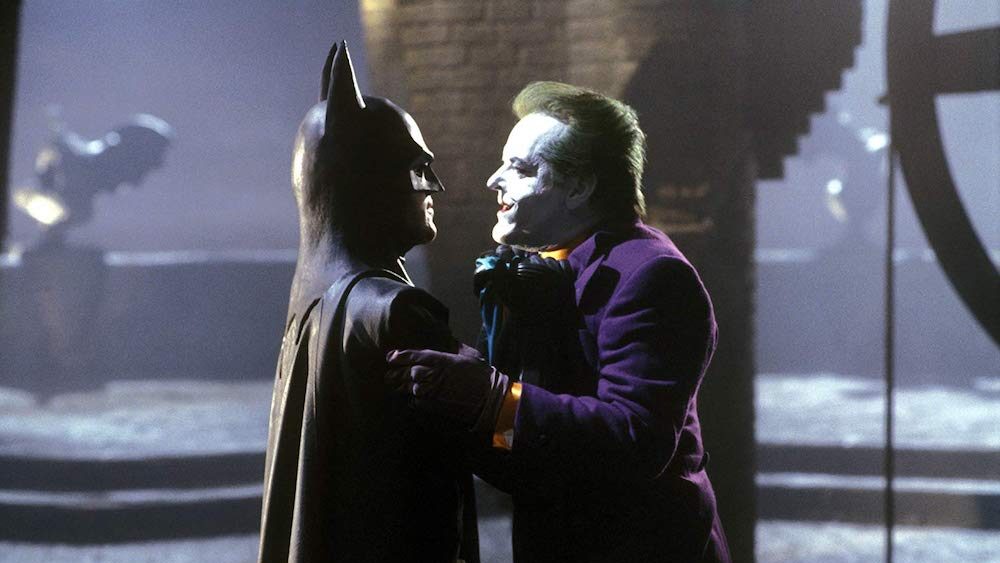
I liken the experience of watching Tim Burton’s Batman to that of reuniting with a long lost friend. After having to endure the relentlessly campy TV series starring Adam West, we now have a more mature version of the story – grittier, darker, and more stylish in its approach. It regards its hero, played by Michael Keaton, not as a figure of fun but as a brooding, shadowy, tormented soul bound by his sense of duty. Gotham City is no longer a mishmash of cardboard sets, cheap art direction, and Los Angeles exteriors; it’s an imposing cornucopia of gothic architecture, with skyscrapers that seem to rise hundreds of stories. The Batcave is a cavernous monstrosity that left me awestruck. For the first time in ages, this is the Batman adaptation that gets just about everything right.
In spite of the somber tone, the story is not so serious that it loses sight of its comic book origins. The plot pits the Caped Crusader against his most famous arch enemy, the Joker (Jack Nicholson), who schemes to poison the citizens of Gotham City with tainted household products and makeup supplies. What exactly will happen if you combine the chemicals just right? You’ll die, of course – but not before a big, goofy, red-lipped grin spreads across your paper-white face. “If you gotta go,” muses the Joker, “go with a smile!” He fancies himself as “the world’s first homicidal artist,” which is his way of saying that hapless consumers are canvases for portraits of murder. “I make art until someone dies,” he notes before chuckling insanely.
Perhaps the Joker is more interesting than the title character. But then again, when hasn’t a villain been more interesting than the hero? We already know who Batman is: Millionaire Bruce Wayne, who as a child made a promise to his dead parents that he would rid the city of crime. But do we know the criminals? What diabolical plot will they come up with to test Batman? In stories like this, it’s not about the hero so much as the challenge he will be faced with, and if it happens to be thoroughly preposterous, then so be it. As long as I’m entertained, I can willingly suspend disbelief for two hours.
One of the fascinating concepts this movie explores is that of duality. Let’s start with the obvious. By day, Bruce Wayne is a handsome but not especially heroic-looking man, and in due time, he finds himself falling in love with an ambitious photojournalist named Vicky Vale (Kim Basinger), on assignment to investigate the Batman mystery. By night, Wayne is a full-fledged crime fighter, who relies on a specially designed suit to protect him and strike fear into the hearts of his enemies. One wonders why he would allow himself to fall in love, since relationships have no place in the life of a superhero. How can they? Fighting the forces of evil is a full time commitment.
Then there’s the Joker, although his duality isn’t as easy to define. He began life as Jack Napier, the right hand man of a notorious crime boss hell bent on taking control of Gotham City (Jack Palance). Napier looked normal on the outside, but within, he was cold, conniving, and psychopathic. In other words, what we see isn’t necessarily what’s actually there. When he’s transformed after falling into a vat of bright green chemicals, his physical deformity finally depicts the insanity he carried within. And yet, he’s still a contradiction; colorful yet twisted, laughable yet frightening, amusing yet murderous. One of the film’s best scenes shows him having a conversation with a dead man – burnt to a crisp by Joker’s amped up joy buzzer. To be sure, this movie also delivers as an action spectacle. Batman, in typical superhero fashion, engages in many hand-to-hand fight sequences. He will also be chased up and down the streets of Gotham City as he navigates the Batmobile, which has never looked sleeker. And he will fly in the Batwing; in one of the film’s most spectacular shots, it’s momentarily silhouetted against the full moon, which rests above a sea of clouds.
There’s a questionable moment in the film involving Vicky Vale and Wayne’s longtime butler Alfred (Michael Gough), who makes a judgment call I couldn’t quite suspend disbelief for. In all fairness, Alfred has been the only parental figure in Wayne’s life since the death of his parents; perhaps he was doing what he thought was best for his Master Bruce. Still, the scene doesn’t register, mostly because nothing had been leading up to it. Fortunately for the audience, this is but one minor misstep in an otherwise fantastic comic book movie, which belongs on the same shelf as Superman for sheer entertainment. Batman is a finely paced, neatly plotted, visually striking film, one that finds just the right balance between mature gothic melodrama and escapist stunt spectacular.