At just over 1,800 words, it would be an understatement to say that Ray Nelson’s short story “Eight O’Clock in the Morning” doesn’t go into detail. Despite this, there’s absolutely no question as to what the story is about, or what its message is. It tells the story of a man who, after attending the stage show of a hypnotist, is awoken to two truths: (1) That reptilian-like aliens are living amongst us humans in disguise; (2) that what we see as normal billboards, posters, photographs, and TV shows are actually platforms for the aliens to manipulate and control us, with subliminal messages like, “Marry and reproduce,” “We are the government,” “We are your friends,” “Work,” and “Obey.” Essentially, the reader is asked to consider the possibility that every paranoid conspiracy theory out there is true.
John Carpenter has adapted the story into They Live, an unsuccessful attempt at expanding Nelson’s original concept. It’s not just about aliens living amongst us in secret anymore; for the 1988 election year, it wants to be a pointed commentary on political corruption, classism, and the divide between those who fight the system and those who sell out. Had Carpenter taken the idea more seriously, had he not been so flippant in his handling of character and theme, his anarchic message might have come across and made an impact. Alas, he has made more of an action comedy – not quite in the vein of his catastrophic Big Trouble in Little China, but silly enough to allow for inexcusably bad lines of dialogue like, “I have come here to chew bubblegum and kick ass. And I’m all out of bubblegum.”
Part of the problem is the casting of Canadian wrestler Roddy Piper, who may have the brawny physique of the typical Hollywood action hero but lacks the necessary acting skills to make his character convincing. The end credits tell us the character’s name is Nada. Why neither he nor anyone else speaks his name during the main film, I have no idea; the word is Spanish for “nothing,” and knowing this would have helped underscore not just how down on his luck he is, but also how society values him, and others like him. After drifting into Los Angeles and securing a job at a construction site, he befriends another hard-luck case, Frank (Keith David, his casting far better), who volunteers at a homeless encampment next to a church.
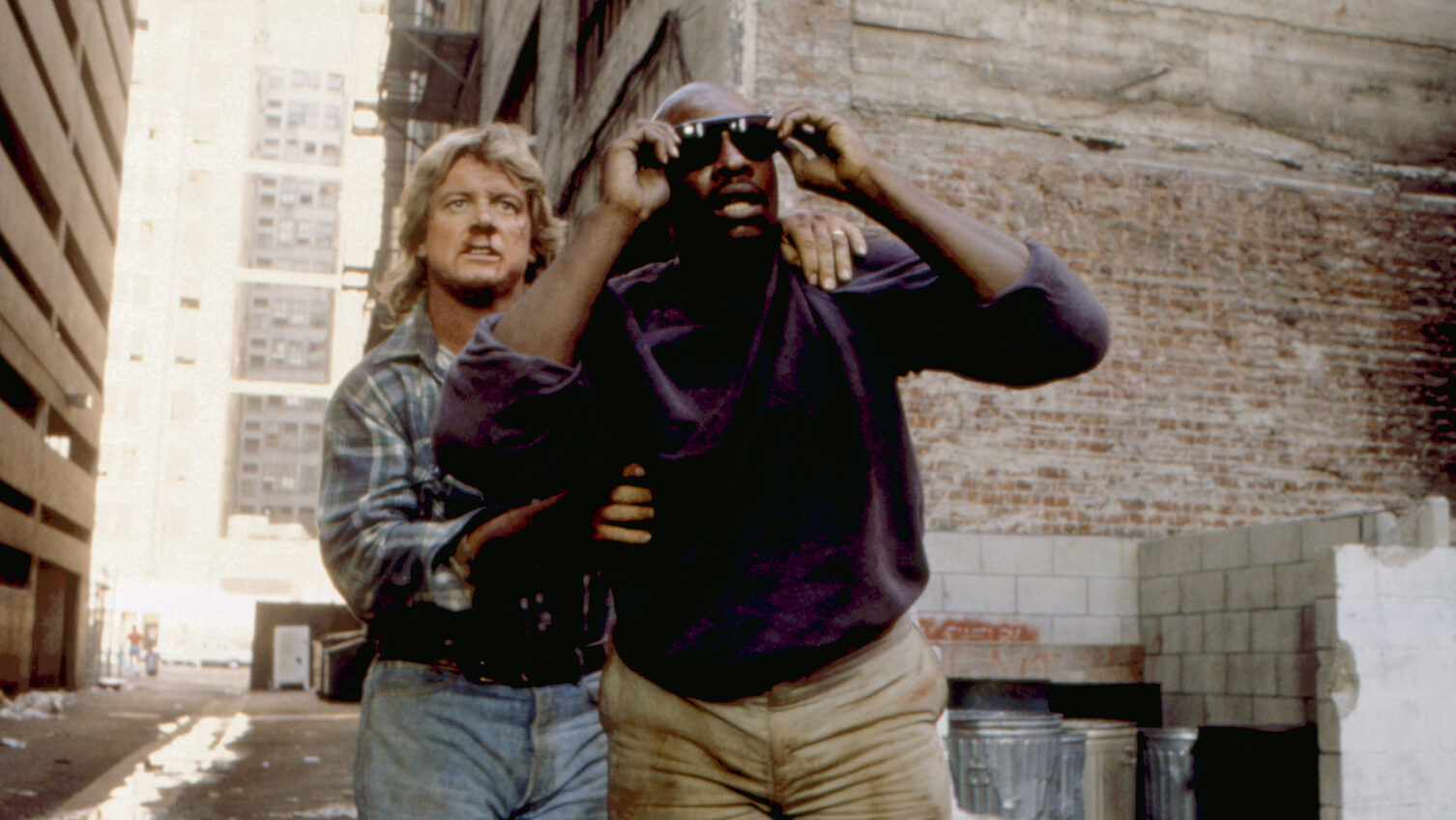
Somewhat similarly to Carpenter’s previous film Prince of Darkness, this church is just a front for something else entirely. But I’ll skip those details and go right to the moment Nada discovers a cardboard box containing very specialized sunglasses; putting on a pair, he’s horrified to discover a literal black-and-white world where much of the population – mostly the rich, powerful, connected, and political – are not human beings at all but rather disguised skeletal alien creatures who communicate, and even teleport, via expensive wristwatches. True to Nelson’s short story, Nada also sees the subliminal words and phrases hidden behind all forms of mass media, from billboards to magazines to TV commercials. Most of the hidden messages were taken directly from Nelson’s story, although Carpenter adds a few of his own, my favorite being, “This is your God” – hidden, of course, on dollar bills.
No question, the underlying concept is fascinating and compelling. But Carpenter repeatedly undermines himself with bad execution. A subplot involving a cable TV employee (Meg Foster) is highly predictable, despite being underdeveloped. And because of several other characters who serve the same narrative purpose, she ultimately proves unnecessary in delivering the film’s message. Much more should have been done with another subplot, this one involving an underground resistance movement aware of the alien menace; so inconsequential are these rebels that the climax involves only the Piper and David characters. I suspect this was mostly for budgetary reasons. But that only begs the question of why the rebels were included in the first place.
The film’s biggest miscalculation, however, is an alley brawl between Piper and David that’s allowed to go on way, way, way too long – over five minutes, if I’m not mistaken, although it felt more like ten or fifteen. Two, perhaps three punches would have been adequate to get the point across. What was Carpenter’s aim with this scene? All it does is bring the film to a grinding halt – which I suppose I wouldn’t have minded had it at least been entertaining, not merely gratuitous. Then again, for a movie just ninety-four minutes long, you can’t afford to waste a second on extraneous material. It’s really a shame that They Live doesn’t work. In another director’s hands, it could have been something special. Ray Nelson could clearly see the potential in a paranoid science fiction fantasy. Why couldn’t John Carpenter?
About The Author