The Muppets and classic literature might not seem like the most obvious pairing. But The Muppet Christmas Carol – which, as the title makes perfectly clear, is a spin on Charles Dickens’ perennial and much adapted novel A Christmas Carol – proves that it can be done. Under the direction of the late Jim Henson’s son Brian, it’s an entertaining display of puppetry and, to a greater degree than ever before, special effects. Not so expected is the film’s successful balance between the Muppets’ particular brand of humor and the story’s more serious themes, including death, economic inequality, and social stature in mid-1800s London. Even with its family-friendly visual and verbal gags, and despite the fact that it’s a musical with songs by Paul Williams, the plot is surprisingly faithful to its source.
A more lighthearted approach was a big risk in and of itself, and they sometimes show it in outlandish ways. Consider the fact that, for the first time, the Muppet characters are billed in the credits as if they were actual actors; Kermit the Frog and Miss Piggy, we’re told, respectively play Bob and Mrs. Crachitt, while The Great Gonzo plays a fictionalized version of Charles Dickens. He, along with Rizzo the Rat, – playing “himself,” the credits inform us – travel throughout the story as both narrators and comedy relief. Add to that the risk of making another Muppet movie after the death of Jim Henson, not merely a puppeteer but the main creative force behind the Muppet franchise. A lot of people had to have been nervous during the making of this film. Fortunately, they ended up being risks worth taking.
Wisely, the filmmakers opted to let a human, Michael Caine, play the Christmas-hating miser Ebenezer Scrooge, a role that requires an emotional range that no puppet can replicate, no matter how well sculpted, articulated, or performed. He effectively captures Scrooge’s bitterness and resentment, as well as his humanity, which, as we all know by now, is incrementally revealed as he journeys through time, learning lessons about his mistakes – and, more importantly, the mistakes he still has time to fix. He’s not the world’s greatest singer, which I suppose is why he’s only given one song. Still, I’d much rather listen to Caine sing a little flatly than see Albert Finney dancing ridiculously, as he did in Ronald Neame’s disappointing musical movie Scrooge.
Despite the fact that The Muppet Christmas Carol touches on the darker, serious social and political themes Dickens was known for, it’s nevertheless light enough in tone that it works as a musical. I think it’s thus far the only story of his that works as a musical. Some will argue the existence of Oliver!, both the stage play and the film adaptation, as evidence that I’m wrong, especially since the latter won the Academy Award for Best Picture. I’m not convinced; Oliver! repeatedly undermined its source with uptempo songs and exuberant choreography. You’d swear Fagin’s gang of child pickpockets were the carefree Lost Boys instead of desperate, easily manipulated street urchins.
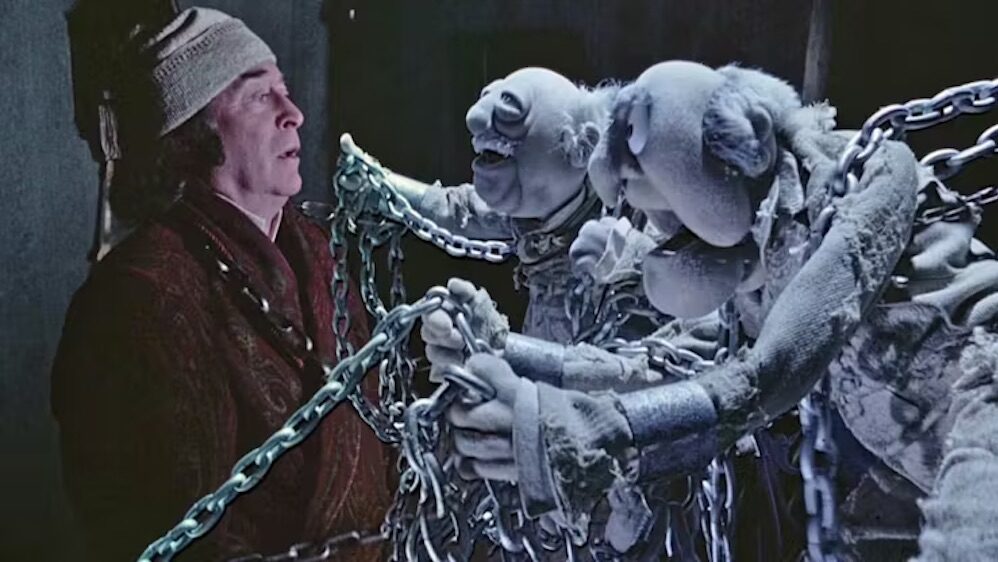
The Ghosts of Christmas Past, Present, and Yet to Come are presented pretty much as we’ve come to expect them – that is, respectively, as an angelic wraith, a jolly Father Christmas figure, and a frightening, mute, constantly pointing counterpart to the Grim Reaper. There are, as would be expected, little narrative changes that make the film more appropriate for the Muppets. Mr. Fezziwig, for example, has been changed to Fozziwig, and per the opening credits, he’s “portrayed” by Fozzie Bear as the proprietor of a rubber chicken factory. And to accommodate the curmudgeonly hecklers Statler and Waldorf, the woeful ghost of Jacob Marley has been split into two characters: Brothers Jacob and Robert, who are still shackled in chains but are more wisecracking and far less pitiful.
There are also a few omissions that literary purists won’t appreciate (then again, if they haven’t figured out by now that this is par for the course when adapting a book into a movie, there’s really no hope for them). Scrooge’s long-since-dead sister Fan, seen only during the Christmas Past segment of the book, was not included, and the beginnings of Scrooge’s hatred of Christmas is not attributed to isolation and parental neglect but rather a childhood-instilled drive to read, study, and work hard. The Ghost of Christmas Present doesn’t open his robe to reveal children representing ignorance and want. And although appropriately sad and dreary, the Yet to Come segment predictably avoids the scene of Scrooge standing next to a reposed dead body hidden under a blanket.
Was this necessary? Parents are obviously varied when it comes to what they think is and isn’t appropriate for their children, so I really can’t say. Having said that, I thought of an earlier scene where Rizzo self-referentially asks Gonzo if they should be worried about the kids in the audience during the story’s more frightening moments; “It’s all right,” Gonzo replies, “this is culture.” I’d say that about sums it up. But even if the material has been sanitized, if only somewhat, that doesn’t make The Muppet Christmas Carol a lesser film. If anything, it’s likely to be remembered for generations to come, like the book and several of the adaptations, and be beloved by adults and children alike.
About The Author