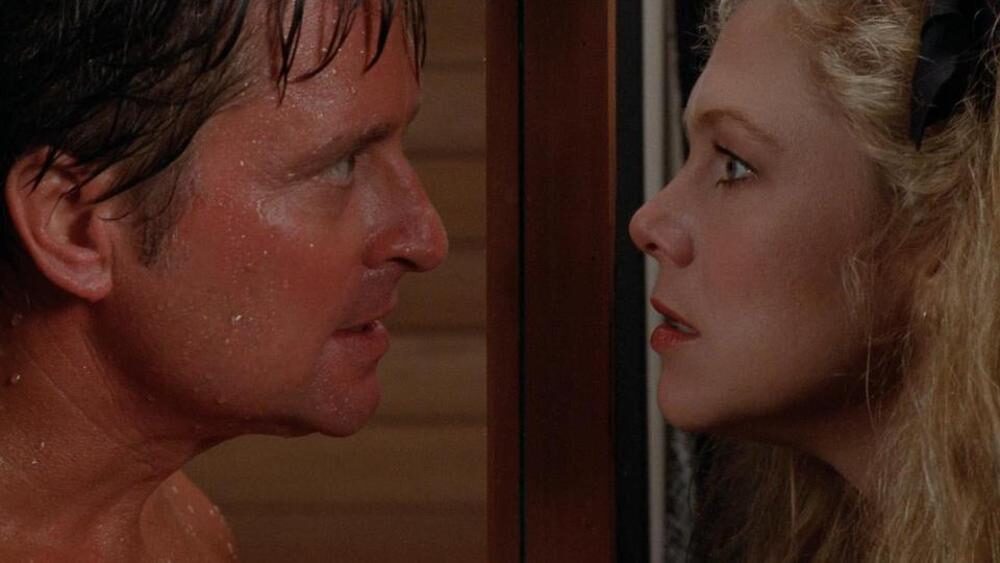
Danny DeVito’s The War of the Roses can be seen – and indeed, has been advertised – as a dark comedy. I admit, there were moments that got a chuckle or two out of me. But the fact that I laughed doesn’t mean that I found the film funny. I don’t consider it a comedy at all, dark or otherwise; much like when I read Warren Alder’s novel, I found the story disturbing, not a portrait of a martial breakdown so much as a devolving of basic humanity. My laughter was likely a psychological defense mechanism against all the unpleasantness, similar to children covering their ears or singing a song when their parents fight. Perhaps, by having a negative effect on me, the film was successful. But I’m not sure that means I have to like it by definition.
I personally don’t think the film is better or worse than the novell. It is, quite simply, different, not just in its structure, characterization, and sequence of events but also in the way the subtext of divorce is examined. The book was published in 1981, when the instant gratification of the 1970s Me Generation crossed the line into selfish decadence; the divorcing lead characters, the affluent Oliver and Barbara Rose of Washington D.C., epitomized that very decadence, living in a palatial mansion filled with expensive antique collectibles ranging from furniture to crystal to figurines to cars to wines. Their moral descent from decent human beings to primal predators was spurred not by custody of their children or accusations of infidelity, but rather by who gets the house. It’s the status-dictated need to procure that drove them more than anything else, and made them inflexible.
DeVito’s film takes a different approach. Although the Roses are still affluent and remain collectors of antiques, the darkly satirical depiction of Reagan-era materialism is replaced by a more general look at people who seemed one way when they first met but turned out to be another. In what can only be described as a Romancing the Stone and The Jewel of the Nile reunion, the Roses are played by Michael Douglas and Kathleen Turner, who start out very much in love but begin to show signs of deep-seeded resentment not long after their marriage, at which point attorney Oliver becomes increasingly consumed by his climb up the legal ladder. At the same time, Barbara, a former gymnast, shows interest in becoming a caterer – although it seems more of a casual interest in the film, whereas she’s fully committed and constantly cooking in the novel.
Divorce proceedings begin when Oliver, away on business, is hospitalized for severe chest pains. It turns out not to be a heart attack or anything fatal, but that isn’t the point; although Barbara is called, and although she seems shocked and claims she will hurry to be by his side, she ultimately doesn’t show up. It only gets worse when she admits that, upon hearing the news, and upon their shared initial belief that he could die, she actually felt happiness. So begins a tragic, morally bankrupt game of one-upsmanship, their efforts to drive each other out of their upscale mansion growing increasingly childish, destructive, and personal until it becomes frighteningly primal. It wasn’t fun to read, and it most certainly wasn’t fun to watch. Do the events of the divorce cause the Roses to act the way act? Or is the divorce merely bringing to the surface suppressed emotions that have always been there?
To an extent, I’m aware that the story, in either form, was intended to be unsettling. My issue with the film is that it’s presented as a twisted dark comedy, DeVito apparently relishing the chance to outdo the bumbling murderous intentions of the characters from his own Throw Momma from the Train. But with The War of the Roses, he’s assuming there’s something inherently funny about spouses giving in to base animal instincts in the face of divorce. There isn’t. It’s just sad, and needless. The message has shifted from a warning against placing value on things instead of people, which may account for why the Roses’ two children, played as teenagers by Sean Astin and Heather Fairfield, are barely featured and no longer have a part to play in the shocking climax; it’s now about divorce itself, specifically whether or not it’s worth going through hell for.
In addition to director, DeVito, another alumnus of Romancing and Jewel, acts as co-star, playing Oliver’s friend and divorce attorney Gavin D’Amato. In those capacities, he doesn’t bring mich to the table, except a few moments of comedy relief. He’s much more effective as the film’s narrator, telling the story of the Roses to an unnamed man (Dan Castellaneta) looking to divorce his wife. He sits in D’Amato’s incredibly spacious office, saying not a word as D’Amato regales and chain smokes, picking the habit back up after thirteen years without nicotine. He makes it clear to the man that if a lawyer who charges over $400 an hour is willing to give free legal advice, he would do well to listen. Should movie audiences listen to what’s said in The War of the Roses? That depends on how funny you think nasty divorces are.