Throw Momma from the Train, the first theatrically released feature film directed by Danny DeVito, is an awkward, bizarre cross between an homage to the suspense films of Alfred Hitchcock, a comedy of errors, and a dark slapstick farce. There’s no seamlessness to the material, no sense of atmospheric balance; one second it’s a wacky physical comedy, the next it’s a grim story of questionable characters plotting the murders of unlikable people no one would miss. It probably would have been better if DeVito hadn’t tried to bring such disparate elements together, if he had simply chosen one specific tone. It doesn’t help that, at a scant eighty-eight minutes, a great many plot advancements, some as basic as a character physically getting from one place to another, are casually glossed over.
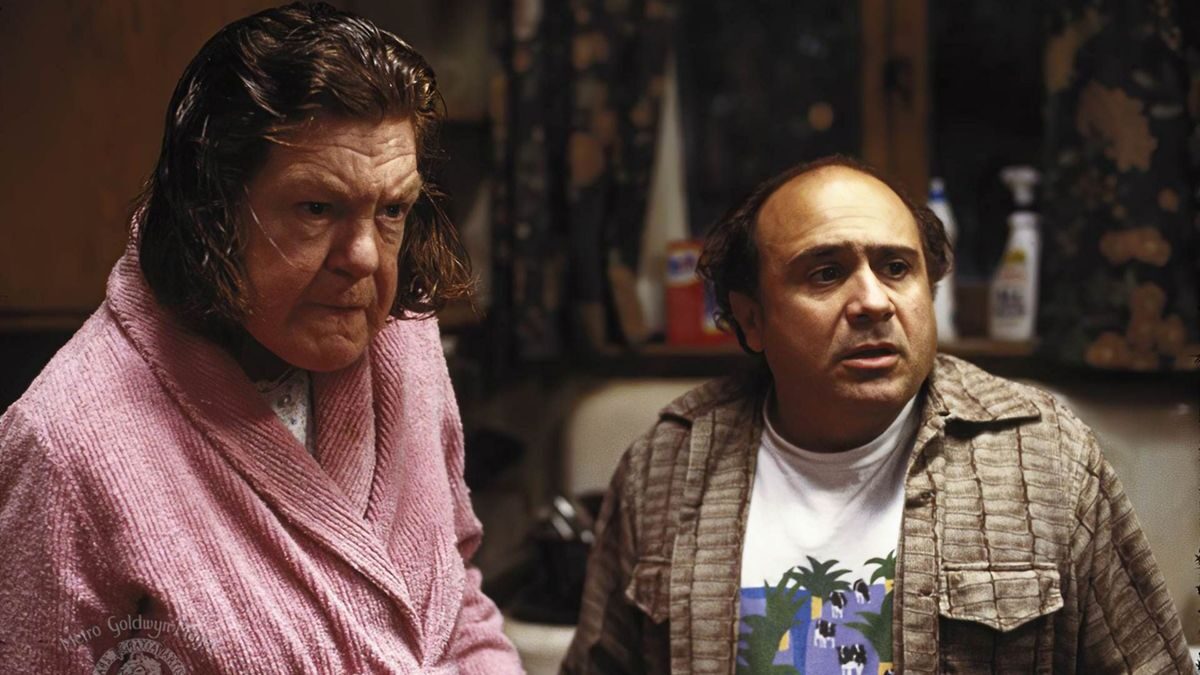
DeVito cast himself as Owen Lift, an unsocialized, overeating, simple-minded aspiring writer. He lives with his mother (Anne Ramsey), an hateful old woman who berates, abuses, and belittles him in almost every scene she’s in. She slaps him, calls him names, looks down on his writing, treats him as a servant, and screams about imaginary plans to send her away. In only a handful of moments can she muster loving words, and even then, one wonders if it’s emotional manipulation. Well on his way to becoming the next Norman Bates, Owen has violent fantasies of killing his mother. He never goes through with it, though, because of course there’s a part of him that, for whatever reason, still loves her. Only in a more thoughtful and tonally consistent film would his complicated feelings resonate.
The other central character is Owen’s community college creative writing teacher, Larry Donner (Billy Crystal). He’s a novelist suffering from an extreme case of writer’s block, his jealous and resentful mind consumed by thoughts of his ex-wife Margaret (Kate Mulgrew) and her undeserved literary success – made possible, we gather solely through hearsay, by stealing Larry’s previous book idea and passing it off as her own. His inability to focus on anything other than Margaret is driving a wedge between Larry and his girlfriend Beth (Kim Greist), who’s understandably irritated about the whole thing. She’s not irritated enough, however, to call it off with him entirely; she has a semi-neurotic personality that allows her to turn a blind eye to Larry’s shortcomings. Anyway, Larry’s hostility is such that he publicly expresses his hatred of Margaret, and his wish for her to be dead.
Owen enters Larry’s life in a way not too far removed from a stalker. This is despite the fact that we’re supposed to find Owen wounded and pathetic rather than creepy and psychologically stunted. He will follow Larry – sometimes to his home, sometimes by phone, even though it’s not explained how Owen got hold of his teacher’s home number – and pester him with questions about writing and desperate pleas for validation. When Larry finally agrees to explain the workings of a good murder mystery, Owen misinterprets this as an agreement that they each will kill for the other man. In other words, Owen will kill Margaret and Larry will kill Owen’s mother, and because they each have no connection to the victim, there’s no motive to tie them to the crimes. This is, of course, the same plot device seen in Hitchcock’s Strangers on a Train, a film Owen intently watches and takes inspiration from.
One of the problems is DeVito’s lack of attention to detail. Take, for example, Owen going to Hawaii with the intent of murdering Larry’s ex-wife; the way the scenes are structured, he’s in his Los Angeles home one minute and in another state the next, only to return as quickly. But how was he able to take a two-day vacation without his mother noticing? Why doesn’t she bring it up later in the film? We never see Owen working, so where did he get the money for plane tickets? Was it his mother’s money? Wouldn’t she notice that as well and then hold it over him for the rest of his life? Furthermore, without getting into specifics, how could the events of the final act so quickly and neatly turn Larry from prime suspect to not even a person of interest?
My guess is that DeVito was hoping audiences would care more about the slapstick humor, some of it coming directly from cartoons. For instance, Owen and Larry remove the hinge pins from the basement door so that Mrs. Lift will fall through when hanging her shawl on the door’s hook; when she finally hangs the shawl, the door doesn’t budge an inch, but of course it falls off when Larry inspects it, causing him to ride the door down the basement stairs as if he were on a sled. I also suspect DeVito wanted Throw Momma from the Train to be more about whether or not Larry breaks through his writer’s block. The problem is that Larry isn’t all that engaging a character, and so I never much cared about his predicament. For that matter, I didn’t much care about Owen, not a sympathetic man but a lost boy in dire need of psychological help. One wonders if he’s the same mental patient DeVito played in One Flew Over the Cuckoo’s Nest.