Don Siegel’s The Beguiled, adapted from Thomas P. Cullinan’s novel A Painted Devil – unread by me, admittedly – culminates with decisions and actions that, when viewed from a distance, support broad, male-conceived psychological notions of women, most notably Freud’s Oedipal Complex and Penis Envy, and even man-centric notions like Castration Anxiety. Viewed closer, the film transcends all that psychological mumbo jumbo and proves far more insightful. It’s a grim examination of living an isolated and inexperienced existence, the conditions exacerbated by war, gendered educational limits both imposed and internalized, and the era-specific, unspoken cultural mandates to repress all feelings and desires.
It’s set during the Civil War, and the vast majority of the action takes place within the walls of an all-girls boarding school located deep in wooded Confederacy territory. It’s very quickly established that the girls, and the women who teach them, live an existence so sheltered, so distant from the realities of the outside world, that they’re pathetically ignorant. No doubt the chauvinist attitudes of the time had a huge, if not the sole, hand in this; the men, they were taught, are supposed to kill and be killed in war, while women are only supposed to be demure, barefoot, and domestic. At this school, their only apparent “education” consists of etiquette, religion, and learning how to speak French.
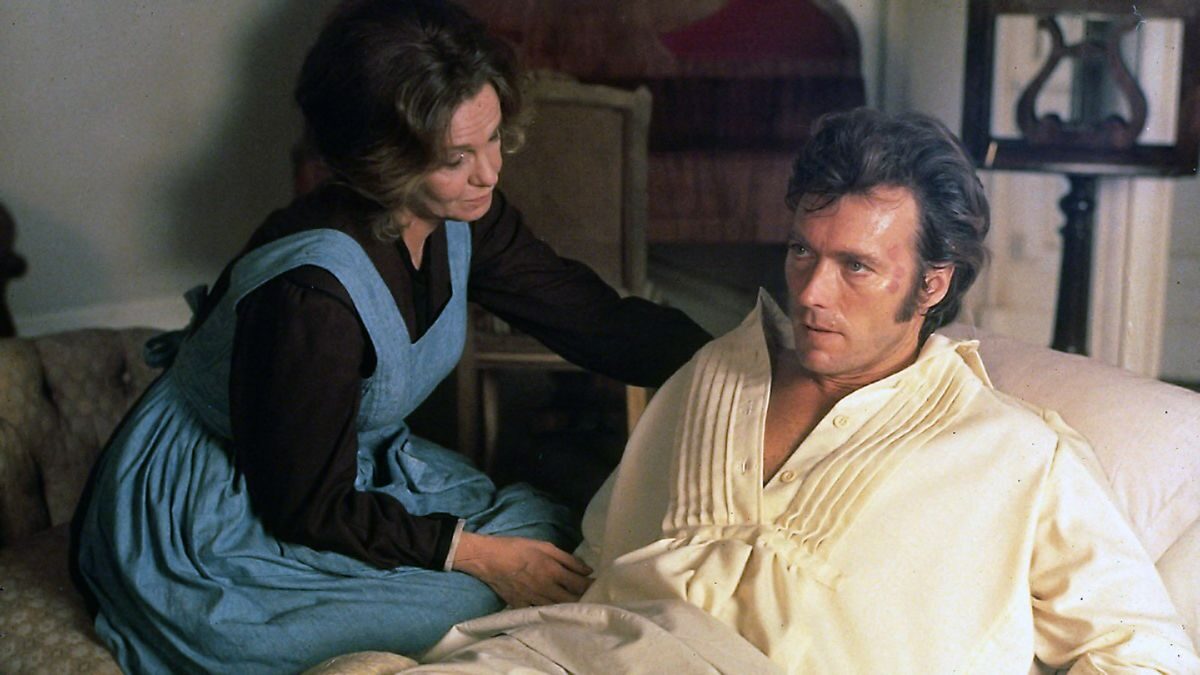
Into their lives enters injured Union soldier John McBurney (Clint Eastwood). It should be a clear-cut decision to turn the enemy over to the Confederate army, but it isn’t. They have a man in their midst. Not some soldier who passes their house from time to time, and certainly not an absentee father or an unorthodox former lover, but an actual man. Having him stay in their house is a cross between keeping him prisoner and nursing him back to health. Likewise, their collective reaction to him is a cross between fascination and fear. It’s like the excitement and danger of doing something you’ve never done before.
McBurney, for whom the discrepancy between what he says and has actually done is significant, is quick to notice this about the girls. He’s even quicker to use their naïveté to his advantage and find very specific ways to gain the trust of each. With headmistress Martha Farnsworth (Geraldine Page), he plays off of her … unusual relationship with her now deceased brother. With schoolteacher Edwina (Elizabeth Hartman), he tempts her into finding out whether or not all men are like her father, who caused her to distrust men in general. For teenage student Carol (Jo Ann Harris), he feeds into her rebelliousness and promiscuous behavior. He behaves similarly towards twelve-year-old student Amy (Pamelyn Ferdin), whose burgeoning womanhood breeds an adolescent crush. He even manipulates the loyal house-slave Hallie (Mae Mercer) by reminding her of what the Union army is fighting for.
McBurney’s presence eventually affects all, but only the girls are affected initially; expectantly, they fall into the traps of jealousy, deceit, and betrayal. The implication is that, if they were part of the everyday world, if they had had regular contact with various types of men, they may have learned to recognize the warning signs men like McBurney unconsciously send. At a certain point, McBurney starts to be affected by his own actions, and he’s eventually disabled in a very shocking, very personal way. Maybe he’s just as ignorant as the girls; if he had more experience (and enough common sense) to see women as more than domestics, he would understand that they have emotional needs as well, and that toying with emotions can be dangerous.
The film isn’t funny, and yet there’s a dark humor to the final scene. That’s when the girls’ domestic education, the only education they were allowed to get, is actually useful for the situation at hand. Up until that point, we naturally think only of what they were denied as women of 1860s America, that the sexism and assumed gender roles of the time prevented them from achieving academically and socially. Cynical audiences will see The Beguiled and conclude that it’s a radically feminist response to sexism, not just from the days of the Civil War but from today as well. More in-tune audiences will see it as a cautionary tale of what ignorance, repression, and isolation can do to anyone, gender notwithstanding.