2005’s Fantastic Four was financially successful but not well received critically. For my part, I thought it was fun – a comic book movie that wasn’t afraid to be no more or less than what it was. Now we have a new Fantastic Four, which unfortunately is competing with a seemingly never ending onslaught of interconnected superhero movies, be they part of the Marvel Cinematic Universe, the DC Extended Universe, or the X-Men films. In spite of this saturation, which I’m admittedly growing tired of, I enjoyed Fantastic Four, not for its originality so much as for how the story was reinterpreted. Whether it’s more faithful or less to San Lee and Jack Kirby’s comic strip, I can’t say; I’ve never been a reader of comic books. But as I wrote in 2005, “as long as the end result is watchable and entertaining, an adaptation can be as unfaithful as Casanova for all I care.”
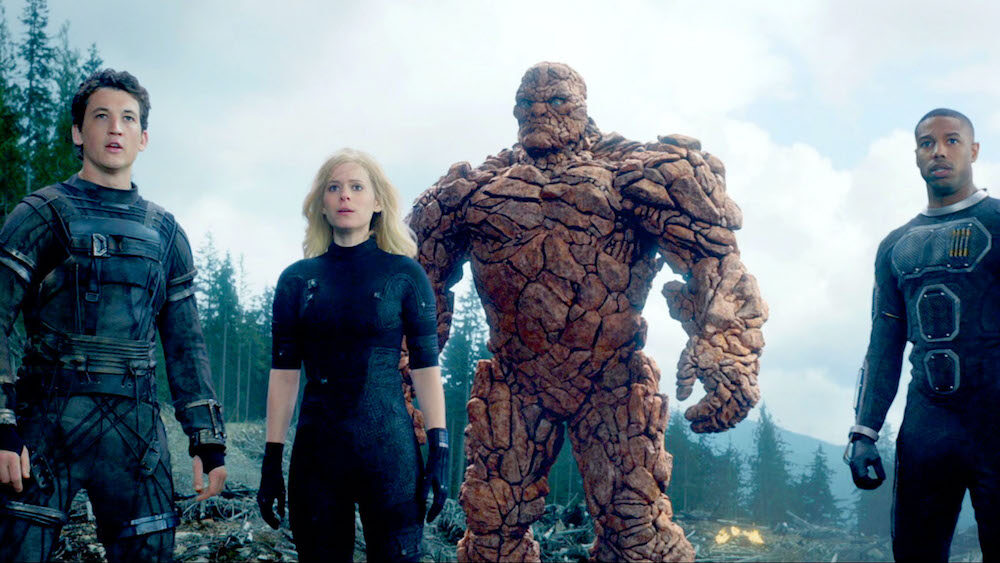
It’s definitely not the same kind of film that was released in 2005; that version was lightweight, jokier, and more family friendly. This new version is darker and grittier, and the characters were written with a greater sense of angst. Please understand that when I say “darker and grittier,” I don’t mean it’s brooding and melancholic, as was the case with Zack Snyder’s catastrophic Superman reboot Man of Steel. Watching Fantastic Four, you’re still aware that it originated from a comic book, and even with the angst, the filmmakers still manage to squeeze a little fun out of it. It now goes without saying that we get the usual stunts and special effects. That’s just a given at this point. What is worth noting is that ten years is plenty of time for computer technology to develop, and it shows in the more convincing renderings of elastic, invisible, fiery, and rocky bodies – the latter a fine replacement for the first film’s use of prosthetic makeup.
The renderings are applied, respectively, to Reed Richards (Miles Teller), Sue Storm (Kate Mara), Sue’s brother Johnny (Michael B. Jordan), and Ben Grimm (Jamie Bell). Unlike with the 2005 film, where the main characters are depicted as adults, the 2015 film portrays them as just out of high school, likely to better appeal to the teenage demographic. In the case of opposite best friends Richards and Grimm, they’re introduced as fifth graders, the former as a misunderstood and mocked scientific genius from the suburbs who successfully creates a teleporter, the latter as a tough kid from an abusive family that owns a car junkyard. All four have more rounded personalities. Setting aside Richards and Grimm, Johnny is just as reckless as the Chris Evans version of the character, but he’s no longer an egotistical wiseass; he’s rebelling against his father (Reg E. Cathey), who always placed work above family. As for his adopted sister, I would wager she’s somewhere high on the autism spectrum, even-tempered but also intensely focused and always in search of patterns, even in music, which she needs to help her think more clearly.
As before, they gain their special abilities after being exposed to a special kind of radiation. But this time, instead of it happening on a space station, it happens in an alternate dimension – a volatile planet of craggy cliffs, violent storm clouds, and magma-like spews of glowing green energy. Also affected is the appropriately named Victor Von Doom (Toby Kebbell). Rather than an arrogant and decidedly unsubtle tech billionaire, as he was in 2005 when played by Julian McMahon, he’s a moody, fatalistic, socially isolated young scientific genius who despises authority, especially the now involved American government. He believes, not without good reason, that the government is out to exploit both his team and the alternate dimension. Most of us already know that he will transform into the evil Dr. Doom. I leave it to you to discover how this happens and what his intentions are. They can’t be good, not with a name like Von Doom.
Unlike Marvel Studios’ insufferable Ant-Man, an unserious and juvenile film that constantly pelted the audience with jokes that ranged from corny to excessive, Fantastic Four shows restraint; director Josh Trank, who also helmed the strangely compelling Chronicle, allows humor only when it’s appropriate. The best example is when the main characters teasingly discuss what their team name should be – a scene helped by an edit I found surprisingly clever. On the same token, Trank could have allowed the pendulum to swing too far in the opposite direction, making the whole film dour and miserable. This was certainly the case with Man of Steel, for which even a single scene of levity was expressly forbidden. Somehow, Trank found just the right balance.
There are two things about Fantastic Four that genuinely surprised me. One is that there was no mid- or post-credit sequence that hinted at a sequel. The other is that, unlike all the recent films adapted from a Marvel comic book, Stan Lee doesn’t make a cameo appearance. I’m not saying he’s under any obligation to make one, but you have to admit, it’s something audiences are not only used to but have fully come to expect. I’m also not saying that it was a dealbreaker for me, especially in regards to a scene after the credits. If anything, it was refreshing. For once, let’s not be teased with narrative possibilities. Let’s just enjoy the movie that’s playing. If a sequel comes out of it, it will at the very least be a genuine surprise. If there’s one thing comic book adaptations haven’t been for quite some time, it’s surprising.