I’m not saying that Fantastic Four was any great work of art. But it was a comic book movie, and as such, I gave it a lot of leeway. It was silly, but it also achieved what it set out to achieve, and it was fun. Now we have Fantastic Four: Rise of the Silver Surfer, and this time around, there’s no fun part of the equation. Yes, many of the hallmarks are there: High-concept science fiction; stunts and special effects; a fight to the finish that heavily damages a major metropolitan area, in this case Shanghai. And this time around, there’s also an alien invasion. But unlike with the previous film, there isn’t a cohesive plot holding it all together. There’s also a great deal left unexplained, not at all helped by a condensed running time of just ninety-two minutes, about seven of which make up the end credits.
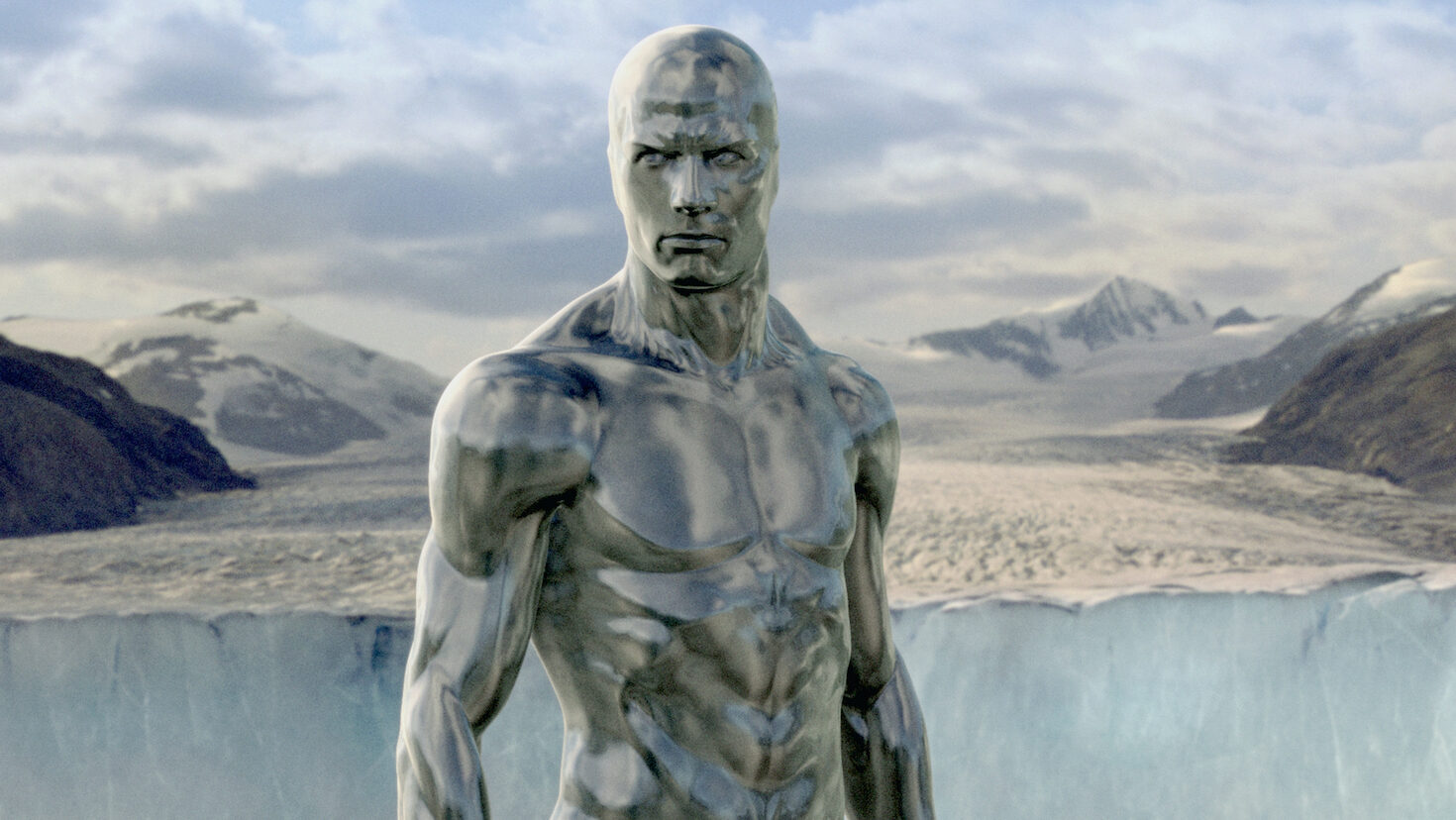
The plot: The Fantastic Four – Reed Richards/Mr. Fantastic (Ioan Gruffudd), Susan Storm/Invisible Woman (Jessica Alba), Ben Grimm/The Thing (Michael Chiklis), and Johnny Storm/Human Torch (Chris Evans) – are recruited by the American military to investigate a space phenomenon causing weather changes, power fluctuations, and the creation of massive, deep craters. Initially thought to be some kind of meteor, it’s quickly determined to be a silver-plated man (a CG creation performed by Doug Jones and voiced by Laurence Fishburne) riding what can only be described as a surfboard. Also recruited, much to the chagrin of the Four, is supervillain Victor Von Doom/Dr. Doom (Julian McMahon), who somehow came back to life after his metal-infused body was rapidly super heated then rapidly super cooled.
How did this happen? You may well ask. Indeed, he’s directly asked that question twice, and not once does he answer. The best we get is a brief shot of his eyes opening in his shipping-container prison, which is now housed in the room of a mansion in his home country. Who owns this mansion is not a detail the filmmakers are willing to divulge. The same can be said for the identity of an unknown man with a metal grinder who tries to remove Von Doom’s metal mask in one of the mansion’s grander rooms. This mystery man exits the story as quickly as he enters it, robbing us all of much needed context. There is an explanation for how Von Doom is able to reappear as a man instead of a human/metal hybrid, but I don’t deal in spoilers, not even for disappointing movies.
However, the explanation is undermined by a subplot featuring Johnny Storm, still the insufferable and egocentric wiseass we met in 2005. Let it suffice to say that he’s exposed to something that rewrites his molecular structure, allowing him to swap his powers with those of the other three simply by touching them. Example: When Johnny comes into contact with the elastic Richards as he ties himself around the collapsing London Eye, Richards becomes pyrokinetic and Johnny is able to stretch. The rules under which this abnormality works are arbitrary and confusing, especially since there seems to be a completely different set of rules for Von Doom. Why were his powers taken away while Johnny’s were merely altered? Even fantasy superhero films need consistency.
Although the title characters were introduced as little more than comic book typecasts, character quirks and all, at least the first film showed an effort to make them engaging. This time around, they’re more like goofy cartoon characters from an old Saturday morning show; they’re simplified to the level of puns, one liners, bickering, and awkward moments. The latter is most evident in early scenes of Reed and Susan planning their wedding, complicated by Reed’s compulsive scientific work and Susan’s fear that their marriage cannot survive the media frenzy always surrounding them. The more innocuous approach to the four leads could account for why Silver Surfer received a PG rating, a downgrade from the first film’s PG-13. Strange, given that a few swear words make it into the final cut, mostly from Grimm and Johnny.
Getting back to the Silver Surfer, why is he here? What does he want? Although it’s explained, it’s both brief and opaque. And because we don’t see the world he comes from or the situation he’s in personally, everything he says is really just hearsay – or exposition, if you prefer. Whatever you call it, it involves some kind of cosmic being made of chunks of other planets, fire, and a hell of a lot of space dust. It’s an incredible visual, but why lavish attention on visuals when there isn’t a story worthy of them? I’ve asked that same question many times before, and I’m sure I’ll be asking it again. It’s often said that sequels are never as good as the originals, but Fantastic Four: Rise of the Silver Surfer seems at pains to prove it to be true. It’s as if the intention was to make an inferior movie.