Cartoons and the real world have been cinematically paired before. Who can forget when Gene Kelly danced with Jerry the mouse in Anchors Aweigh? Or when Aurora Miranda kissed Donald Duck in The Three Caballeros? Or in Mary Poppins, when Julie Andrews and Dick Van Dyke danced while singing “Supercalifragilisticexpialidocious” in an animated park? But nothing has come close to what has been achieved in Who Framed Roger Rabbit. Here’s a real masterpiece of technological innovation – a film that, for the first time in my years of watching movies, truly made me believe that cartoons are real. But it’s also a masterpiece of storytelling, an engaging period detective murder mystery crossed with delightfully wacky animated adventure. It is, above all, one of the best films of 1988.
At the risk of disappointing literary purists, the film is not faithful to Gary K. Wolf’s novel Who Censored Roger Rabbit?, in which the title character is not only the murder victim but also was the kind of cartoon that appears in print, and his words would physically appear over his head in thought bubbles. Personally, I wasn’t bothered by this at all. That’s because the filmmakers came up with a better idea: Have the cartoons be movie stars, and mix the new characters with well established ones from the likes of Disney, Looney Tunes, Tex Avery, and the Fleischer Brothers. Yes, this film has Mickey Mouse paired with Bugs Bunny. In one hilarious and masterfully choreographed sequence, Donald Duck and Daffy Duck duel each other playing pianos. Droopy is an elevator attendant, and Betty Boop sells cigarettes at a nightclub between movie gigs.
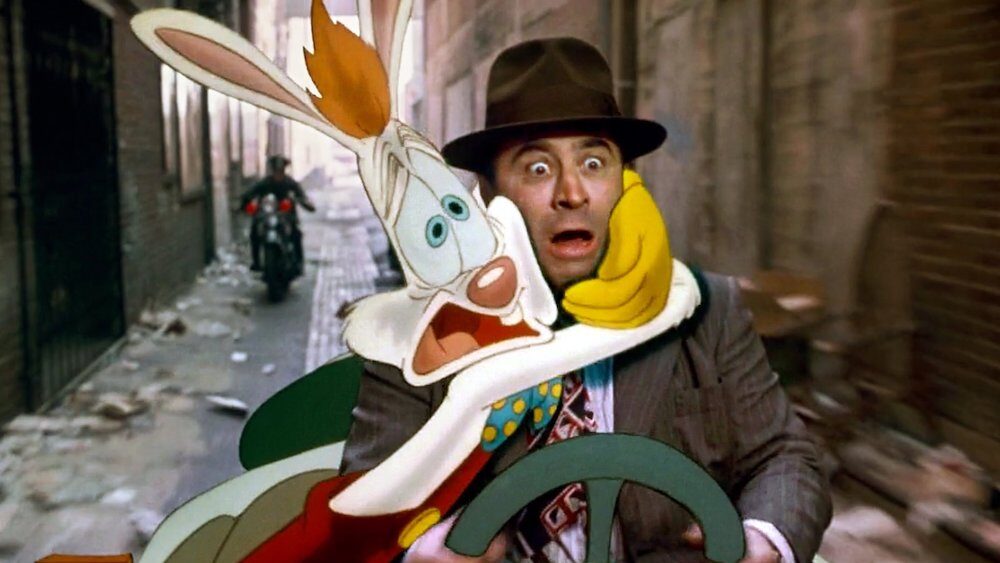
Director Robert Zemeckis, who earned his reputation as a special effects maestro with Back to the Future, seemed to relish making his job incredibly difficult. It paid off, and it was all for the cause of making the cartoons as realistic as possible. They cast shadows. Their shading changes with the lighting, including a swinging overhead lamp. When a cartoon touches a real-world object, the object physically reacts – e.g. doors open and close, chairs are pulled out, menus are held up, guns are drawn, beds mattresses respond to bouncing, human clothing rumples, and when a character runs through a real glass window, a cutout in the shape of the character will appear. There are also several scenes of a cartoon and a human handcuffed together, allowing for all kinds of acrobatic humor. It may seem unnecessary to go this extra mile. But if those painstaking details weren’t there, you wouldn’t be able to suspend disbelief. They really do make all the difference.
In late 1940s Hollywood, where cartoon shorts aren’t drawn but shot in brick-and-mortar studios, wacky toon movie star Roger Rabbit (voiced by Charles Fleischer) is the prime suspect in the murder of comedian Marvin Acme (Stubby Kaye). He was caught having an affair with Roger’s wife Jessica (voiced by an uncredited Kathleen Turner), not a rabbit at all but a buxom, sultry bombshell in a skimpy red dress, with long red hair styled like Veronica Lake. It would help you to know that the toon version of an affair is playing Pat-A-Cake and involves no sex whatsoever. Anyway, Roger insists that he’s innocent. In desperation, he turns to private detective Eddie Valiant (Bob Hoskins), a down-on-his-luck alcoholic who loved and worked cases for toons until his heart was hardened by a personal tragedy.
The more Valiant delves into the case, the more he comes to believe that Acme’s death was about more than a game of Pat-A-Cake. He did, after all, hold the deeds to Toontown, the animated world where all toons come from – and where Valiant will find himself in as the story nears its climax. Now that he’s dead, Acme’s will is missing. It stands to reason that the head of a cartoon studio, the perfectly named R.K. Maroon (Alan Tilvern), would want Toontown for himself, giving him a motive for murder. As if unraveling this tangled mystery isn’t tough enough, Valiant must also keep Roger safe from the clutches of a criminal toon task force led by Judge Doom (Christopher Lloyd), a creepy, imposing, icy man dressed all in black, with a hat, gloves, and a cloak that always billows in a mysterious breeze. His punishments are cruel and unusual; toons may be famous for surviving anvil head blows, but Doom has a disturbing method of literally killing them.
During the film’s most upsetting scene, I immediately noticed a lack of accountability for causing the death of an innocent toon. Although subtle and not the focus of the story, I couldn’t help but infer in that moment that toons are the ethnic minorities of Hollywood, subject to human prejudice and discrimination. In a far less upsetting but quietly telling moment, Dumbo flies outside Maroon’s office window, prompting a quip to Valiant about how toons “work for peanuts.” As if reveling in his superiority, he grabs a handful of literal peanuts and tosses them out the window; Dumbo catches every single one as he flies away cheerfully, perhaps too naive to understand he has just been condescended to. There isn’t a direct allusion to real life Hollywood racism in this film. But the undercurrent is definitely there.
Of course, this will likely be noticed only by adult audiences – who will likely appreciate the film more than children, if only out of nostalgia. This isn’t to say children won’t enjoy the film. On the contrary; between an opening cartoon short bursting with hilarious physical gags, the seamless integration of live action and animation, and the joy of seeing familiar cartoon characters from rival studios sharing scenes together (a shot featuring Porky Pig and Tinkerbell is nothing short of beautiful), children will have plenty to enjoy. Both children and adults will equally marvel at the film’s technical achievements. Who Framed Roger Rabbit is the kind of film that begs the repeated asking of, “How did they do that?” To watch it is to be awed, delighted, and, in the best possible sense, baffled from beginning to end.