One could view Danny Boyle’s 28 Years Later strictly as a continuation of a zombie franchise, beginning in 2003 with Boyle’s own 28 Days Later. It certainly is that, but there’s more to it. The screenplay by Alex Garland, also the writer of the original, draws on old coming-of-age myths, more modern fairy tales, and real-world rites of passage to tell one of the most common stories of all: A boy’s transition into manhood. The zombies – or, more accurately, the people who have been mutated into animalistic flesh eaters because of a virus – are mostly symbolic of all the trials and tribulations of growing up and becoming self-reliant. Even the events devoid of symbolism contribute to the boy’s process of maturation; in the course of this movie, he learns very hard lessons about breaking away, having things taken away, and surviving in a cruel world, all while staying tethered to morality.
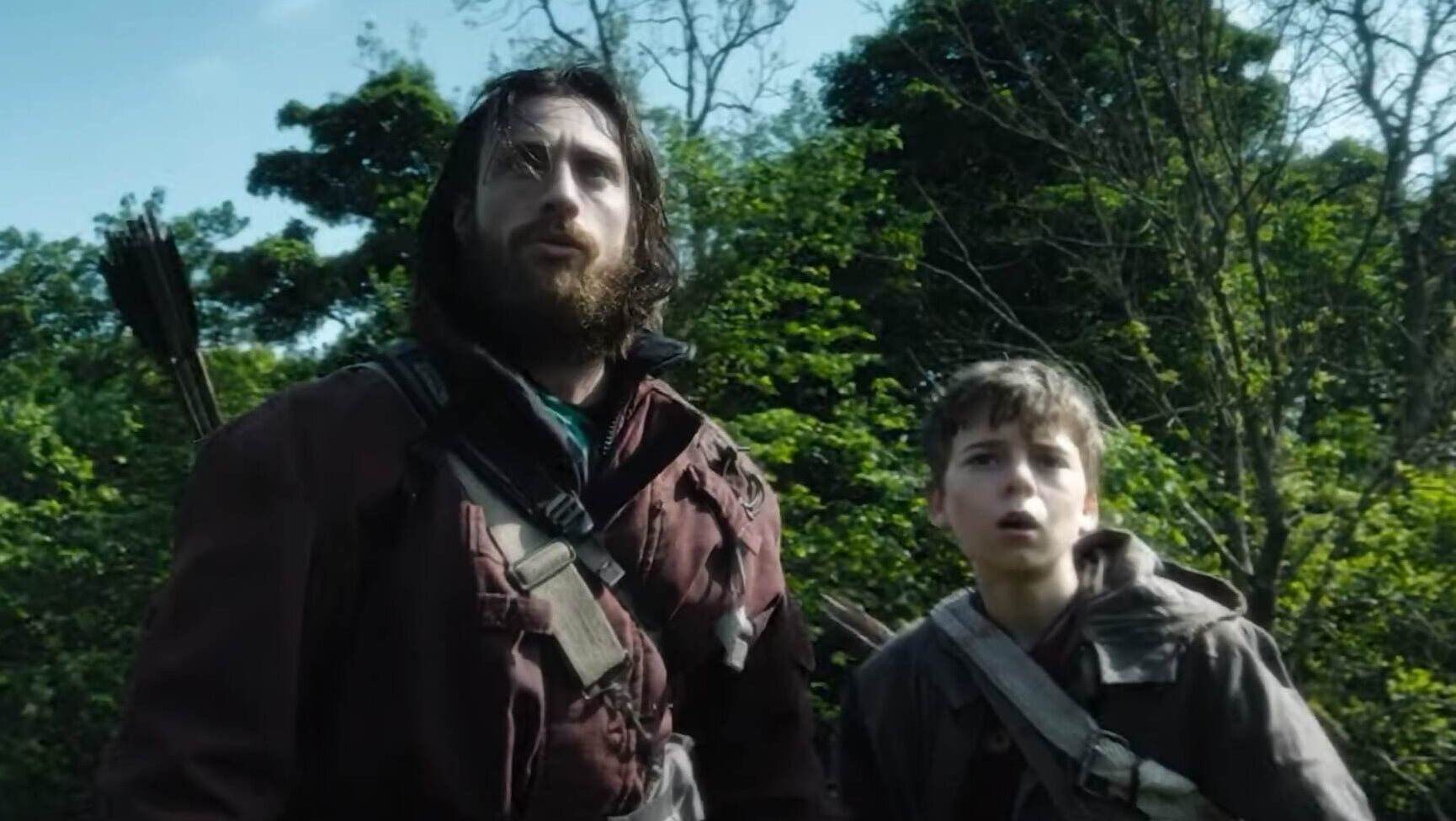
This would be twelve-year-old Spike (Alfie Williams). He was born into the post-apocalyptic world established in the first two films, raised on an isolated but thriving island off the coast of Scotland, which can only be accessed from the mainland by a narrow causeway that disappears every time the tide comes in. His father Jamie (Aaron Taylor-Johnson), a flawed man, feels he’s now old enough to learn how to hunt and kill the infected, who, since the start of the pandemic twenty-eight years earlier, have taken over the whole of the United Kingdom and exist in packs ruled by alphas. When father and son make that low-tide journey across the causeway, armed with bows and arrows, Boyle intersperses brief shots of real marching soldiers and cinematic depictions of medieval knights in battle, all while a recording demands an obedient march rhythm; in this regard, Jamie is old-fashioned, eager to teach his son about the male obligation to be a warrior and protect their families and communities.
In the first of several violent and gory scenes exemplifying why the film received an R rating, Spike proves himself a capable learner. This is not to say he has a sadistic bloodlust; he wants to show his usefulness to his community, and above all, he wants to make his father proud. That is, until he discovers his father’s flaws. Spike understands that his mother Isla (Jodi Comer) is suffering, both physically and mentally, from some kind of illness. What he doesn’t understand is why his father won’t take her to the mainland and seek the help of a doctor rumored to live at the site of a constantly burning fire, especially since their island community is devoid of electricity and basic medical supplies. Realizing Jamie isn’t quite the model of masculinity he presents himself as, Spike takes it upon himself to sneak his mother off to the mainland and find this elusive doctor.
28 Years Later can be appreciated purely as a horror movie. God knows it has enough grisly imagery to make those who like that kind of thing happy. Some would probably say there’s more than enough. I think the blood and guts aren’t there simply to be grossed out by; it’s actually in service of the story’s coming-of-age theme. Every infected creature that comes along is an obstacle for Spike to overcome – not at all unlike the obstacles he would have faced in a normal, zombie-free life, be it competing for a job, struggling to earn enough money to stay afloat, or even other people, some of whom don’t think about what’s in anyone’s best interest. By pushing through his fears, by accepting gains and losses, by understanding that some things just can’t be changed, and by realizing that the situation is as simple as living or dying, Spike can truly grow into a capable, independent man.
This isn’t to say that he doesn’t need help from time to time, nor that he refuses to accept it when offered. His most important encounter is with an uninfected survivor (Ralph Fiennes), who not only helps his mother in the most profound of ways but also teaches him that, even in times when it’s kill or be killed, you should not lose your basic human decency. This is most evident in a subplot I won’t discuss, except to say that Spike finds himself in a position of protecting someone that can’t protect themselves, as was also the case with his mother. The Fiennes character also teaches Spike to view death with reverence, made clear by shrines of bones that, in their own morbid way, are actually beautiful.
The only thing about 28 Years Later I didn’t like was its ending. Tonally dissonant, coming off more like a demented action comedy, it had the feeling of a post-credit scene in a Marvel Studios movie; it not only hints at a sequel but does so in such a way that it seems like superheroes – bizarre, utterly insane superheroes – will be the main characters. I grant you that it was only one scene and it may not completely reflect the direction the story is going in. Still, it was a bad fit for a movie that was otherwise a serious and compelling horror/drama about the road to maturity. As with 10 Cloverfield Lane and 47 Meters Down (I just noticed that all these titles begin with numbers), this is a rare case where you should leave the theater before the movie ends.