I’m not going to deny that Joseph Kosinski’s F1 is well made. A great deal of work must have gone into creating believable scenes of car racing; they have to be choreographed, the stunt people had to be rigorously trained, and the camerawork had to be such that you not only witnessed the cars traversing their courses but actually got a taste of what it’s like to actually be inside them. This movie achieves all that. But there’s something else I’m not going to deny, namely that I was bored out of my mind; the plot is a litany of sports-movie cliches, the characters are formulaic, and the outcomes are predictable. You might as well bring along a checklist of everything you know will happen. In all likelihood, you probably already knew them before stepping into the theater. The trick isn’t to avoid cliches. It’s to use them in such a way that we don’t care.
The film stars and was produced by Brad Pitt. He plays Sonny Hayes, whose dreams of becoming a professional Formula One racer were dashed after an accident at the 1993 Spanish Grand Prix left him with metal screws in his spine. Since then, he has had several failed marriages, he lost all his money as a professional gambler, and he lives in his van. At this late stage, he only seeks out lesser-known or unofficial racing opportunities for little to no pay. Not that it matters; as he repeatedly says, it’s not about the money. It never is in movies like this. Into his life re-enters his Grand Prix teammate Ruben Cervantes (Javier Bardem), now the owner of a failing F1 team. Reuben is in a fix; if he doesn’t get a replacement driver for the one that of course is out for the season, and if his team doesn’t win this year’s race, his investors will fire him. Sonny, Ruben’s proverbial last hope, reluctantly agrees to help.
How many items have you crossed off the list so far? You have more to go. Here’s another case of a film riddled with what I call “of course” moments. Of course Sonny’s age will be ridiculed by Joshua Pearce, the cocky young rookie of the team (Damson Idris). Of course Joshua and Sonny will hit it off like oil and water, only for the former to eventually come to learn from the latter’s years of experience. Of course Sonny will come in with unorthodox, reckless ideas about the right way to race, a constant cause of headaches for Ruben and the crew. Of course Sonny will fall in love with Irish engineer Kate McKenna (Kerry Condon), who of course initially resists his wry charm and handsome figure. Of course what all this is ultimately about is Sonny and his last shot at winning a Formula One race.
I obviously can’t give away the final scenes. Just keep the words “of course” in mind, and you’ll get it. I’m not saying that Kosinski and screenwriter Ehren Kruger needed to reinvent the wheel. Any student of narrative tradition can tell you that such a thing isn’t possible. What I’m saying is that the decision to make the film rote should have been secondary to making it entertaining. I’ll forgive any cliche if I’m having a good time with the story. This points to another problem I had with F1, namely that I find nothing inherently fun or engaging in cars driving the exact same circuit over and over again. If I’m going to watch that kind of thing, I need more than a first-place winner. I need visual stimulation. Consider the Wachowskis’ underrated Speed Racer; now there was a racing movie that was anything but boring. Yes, it was highly stylized and in violation of the very laws of physics, but so what?
I can’t place any blame on the actors, all of whom give competent, appropriate performances. Pitt, with his trademark rapacious smirk and easy-going style of delivery, effectively conveys his character’s mixture of stubbornness, expertise, sarcasm, and world weariness. There was good chemistry between Pitt and Bardem, the latter expertly capturing his character’s affability and desperation. While I didn’t appreciate Condon being reduced to an obligatory love interest, at least she was allowed to be Pitt’s emotional equal. The more compelling female character is a supporting role that’s sadly underutilized. This would be Joshua’s mother Bernadette (Sarah Niles); she may not understand the sport of racing, but she does understand her son’s love of it and does not stand in his way as his star rises. At the same time, being a mother first and foremost, she’s fiercely protective of Joshua and doesn’t take kindly to Sonny’s dangerous racing tactics.
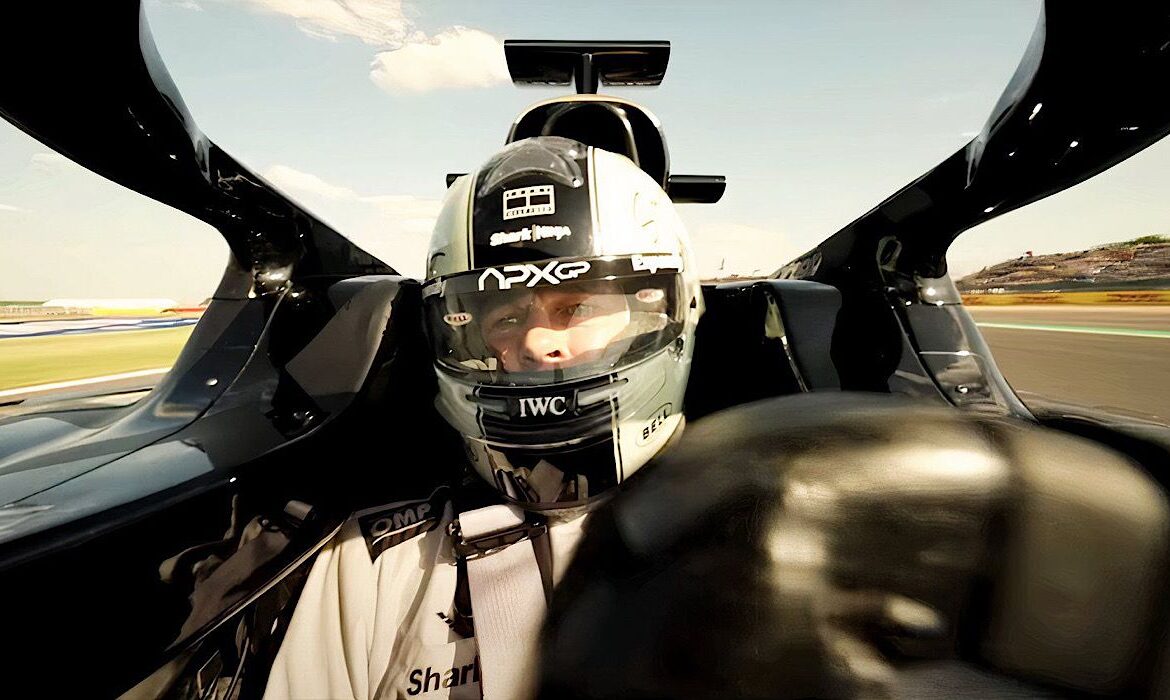
The film is without a doubt an impressive technical achievement. The race sequences – a literal world event, taking place everywhere from the U.K. to Italy to Las Vegas to Abu Dhabi – have all the expected spectator shots of the cars as they weave, dart, and glide around tracks. Not as expected are mounted cameras on the dashboards to the cars; although they’re pointed at the drivers instead of the raceways, they give audiences the closest possible experience of actual driving. This was, I’m sure, a demanding challenge for the filmmakers, one they met and pulled off. What I wanted from F1 was equal effort put into the screenplay, the characterizations, and the underlying themes. A more lively dramatization of race-car driving would have greatly helped. You know something is wrong when you repeatedly yawn during a film’s most exciting scenes.