Is it wrong of me to prefer sense over spectacle? Did I miss the point when I left Disney’s Tron: Legacy feeling it was a monumental failure as a story? If I’m to continue with this review, I must first make it clear that I didn’t see its 1982 predecessor Tron in the same light as its cult fanbase. I don’t believe it deserved praise for its innovative special effects alone. There also should have been an engaging plot, character development, and the sense that it was operating under a heightened but understandable set of rules. I feel the same way about this long-awaited sequel, only stronger. I can enjoy an escapist sci-fi/fantasy with the best of them, but not when all effort is put into visuals and absolutely nothing is put into the screenplay. If that makes me a snob who wouldn’t know a cool movie from a hole in the ground, feel free to stop reading and start searching for a more enthusiastic review.
Watching Tron: Legacy is a little like watching a demo reel from the visual effects department – all style, no substance. That was also true of the first film, but in that case, it was merely disappointing. In the case of the sequel, everything that was wrong to begin with has been amplified to a considerable degree, and it’s just infuriating. Director Joseph Kosinski shows not the slightest effort to make the story plausible or consistent. Physical impossibilities are freely glossed over. The dialogue is unbelievably awkward. The performances are wasted on characters who have less depth than their presentations in 3D (which, incidentally, could have been but thankfully wasn’t utilized in 1982). The plot is convoluted and impenetrable, and it seems the more explaining it does, the less sense it makes. The entire concept of organic people living inside a computer is a logistical nightmare, but if I start rattling off a list, I might not be able to stop.
Its greatest offense is not having any audience in mind other than the original film’s fanbase – which, when you think about, hardly seems big enough to have warranted a sequel in the first place. Still, as was the case in 1982, it can’t be denied that the film is a dazzling sight to behold. I was especially impressed with Clu, a hacking program designed to look exactly like its creator Kevin Flynn, played in both films by Jeff Bridges. Since people age and computer programs don’t, it was necessary to digitally reconstruct Bridges’ face as it appeared not quite thirty years earlier. The results are uncannily convincing. With just a little more development, we may someday see digital recreations of bygone Hollywood icons and not notice a difference. Can you imagine Humphrey Bogart acting alongside Ingrid Bergman in a sequel to Casablanca? Most film lovers would cringe at the idea. I’m open to it. I guess I’m just rebellious that way.
After the events of the first film, Flynn got married, raised a child, became a widower, and was promoted to CEO of computer corporation ENCOM International. He disappeared in 1989, leaving behind his son and vague promises of a cutting edge digital revolution, one he claimed would forever change science, medicine, and religion. Twenty years later, see Flynn’s now grown son Sam (Garrett Hedlund) breaking into ENCOM headquarters, distributing their newest operating system over the internet for free, uploading a virus into their mainframe, and escaping by jumping off the rooftop and opening a parachute he just happened to have stowed away on his person. After his arrest and release, Sam is approached by ENCOM’s consultant and Flynn’s old friend Alan Bradley (Bruce Boxleitner), who received a page from Flynn’s office, the number of which has been disconnected since 1989. So help me God, the man is still using a pager.
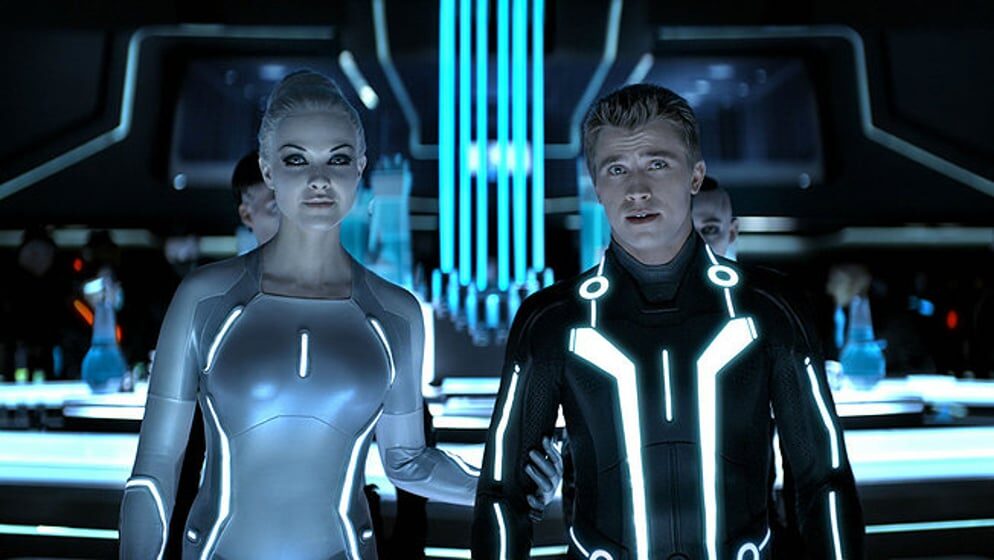
Upon entering his father’s abandoned arcade, Sam discovers a secret room with a miraculously functional computer and a fully operational laser. With a few careless strokes of the keyboard, Sam is zapped with light and transported into the computer world, known as the Grid. We then witness what can only be described as an homage to the sepia-tone-to-Technicolor transition in The Wizard of Oz; the film shifts from 2D to 3D. Sam is immediately captured by electronically-voiced guards in black suits with glowing orange stripes. After being fitted with a glowing suit of his own and linked with a memory-storing disc that doubles as a Frisbee, he’s pitted against Clu, who has turned evil. There’s forced participation in games of survival (the light cycles in the first film make a return), after which Sam is rescued by a program named Quorra (Olivia Wilde) and driven away from the city into the surrounding mountains. Mountains. In a computer grid. And there are clouds in the sky, too.
I will now stop describing the plot and move on to some of the little things that drove me insane. In the Grid, there’s a house stocked with furniture, physical paper books, and food. I must assume it’s not some digital replication, for Sam is able to eat it without a problem. There’s a club high atop a sky rise in the heart of the computer city, where a program played by Michael Sheen struts around with a cane and speaks like a Dr. Frank N. Furter wannabe. The ending begs the question of how anything created in a computer could ever exist in the physical human world; after all, it’s all just a bunch of immaterial zeros and ones. The fact that I’m fixated on this when I’m supposed to be enjoying myself should tell you everything you need to know. Like its predecessor, only more so, Tron: Legacy is a horrendous miscalculation. It’s one of the year’s least understandable films.