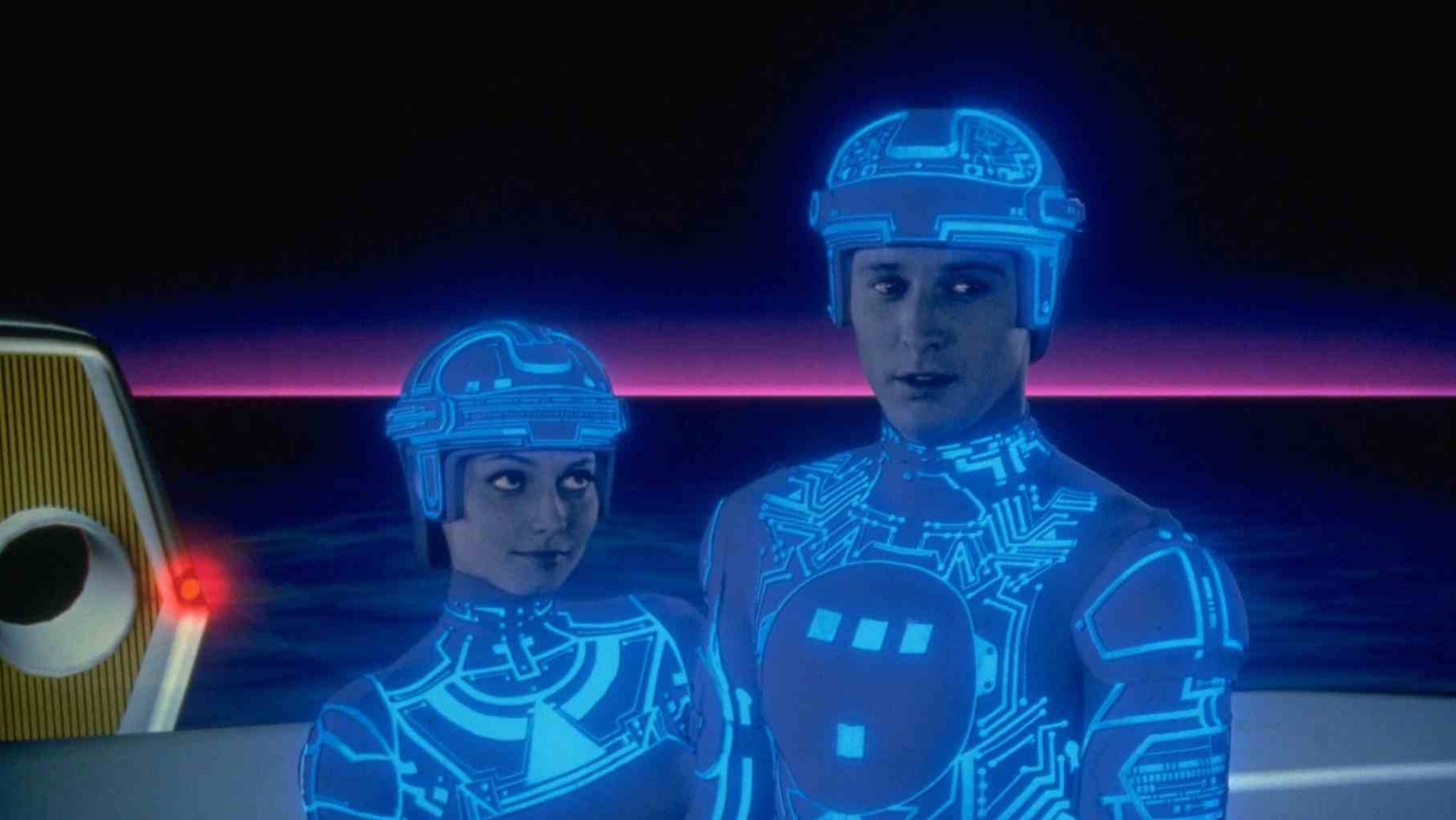
Tron (1982) Directed by Steven Lisberger Shown from left: Cindy Morgan, Bruce Boxleitner (as Tron)
Tron, the most technologically experimental film to ever come from Walt Disney Productions, is a prime example of style over substance. There’s no denying the work that went into the visuals; in conjunction with more traditional effects like backlit animation, matte paintings, and rotoscoping, an entire world, a world of digital programs and living arcade games, was painstakingly rendered using computers. It wouldn’t be hackneyed to say that simply looking at the film is a breathtaking experience. There’s also no denying that the visuals are at the mercy of a subpar screenplay and misguided directing; the plot is thin, at times downright incoherent, and the wooden performances are made worse with lines of dialogue that are awkward at best, embarrassing at worst. It’s not as bad as The Black Hole, another ambitious sci-fi film from Disney. But that’s like saying it’s better to be sick with a cold than the flu.
In this film, computer programs, represented by actors in white costumes and helmets covered in glowing stripes and symbols, look exactly the same as the flesh and blood programmers that created them. The programs refer to their creators as Users. I can buy that. What I can’t buy is the idea of a human getting transported into a digital world after getting zapped with an industrial-sized laser. Organic material transformed into immaterial ones and zeroes? Then reforming completely intact and in full possession of motor functions, personalities, and emotions? Even for a science fiction concept intended to be of a heightened reality, that doesn’t make sense. Nor do programs that exhibit very human traits like laughter, anger, evil, and love. And I can’t begin to explain why the authoritarian bad programs want to oppress the good programs and their “belief” in Users. Religious persecution? In a computer?
The human User trapped in the digital world is Kevin Flynn (Jeff Bridges), a cocky young software engineer and current owner of an arcade. Once employed by a major tech corporation, he’s out to prove that his unscrupulous former boss (David Warner) not only took credit for his video-game designs but used them to climb the corporate ladder all the way to the top. The proof Flynn needs is hidden in a computer file, which is being kept hidden by Warner’s program counterpart, who is in turn the subordinate of the evil and apparently sentient Master Control Program, MCP for short (a computer generated cone of red light with Warner’s electronically altered voice). The MCP catches Flynn in the act at a keyboard, and promptly sucks him into the world of the computer. To what end, I don’t really know. Was this an attempt to have Flynn murdered?
In this computer world, known as the Grid, programs are rounded up by the MCP’s fascist henchmen and forced against each other in to-the-death games. The special effects really shine in these scenes; there was an especially well-rendered race sequence, where motorcycle-like vehicles make the absolute sharpest of turns and trail colored lights behind them in solid lines. I’m just not sure how any of it works logistically, Flynn being a human being and all and everything else a digital representation. Yes, I’m aware this is a science fiction/fantasy story. But even then, there has to be some degree of logic at work. Be that as it may, Flynn is rescued from the games by a program named Tron (Bruce Boxleitner), who of course has a human User counterpart in the real world – and he just happens to be not just a programmer at Warner’s tech company but the new boyfriend of Flynn’s ex (Cindy Morgan).
It’s this User Tron wants to send information to. Should Tron hear back, it should allow for Flynn’s missing files to be declassified and the MCP to be stopped once and for all. I can suspend disbelief for what’s essentially a computer-generated good vs. evil story. It’s the smaller details writer/director Steve Lisberger included that ruin the illusion for me. How can Flynn – who, again, is a flesh and blood human – replenish his energy levels by drinking from what I can only describe as a river of power, which looks every bit like the water it actually was. That may be fine for the programs, but wouldn’t that kill Flynn? And what am I to make of Flynn’s sudden unexplained ability to control aspects of the Grid with just his touch? How is that even possible? What does it mean for the plot, and I mean apart from a convenient way to get from one scene to the next?
Perhaps I’m not the right person to review this movie. Tron was obviously made in the spirit of entertainment and escapism, but my logical brain kept getting in the way of that. Having said that, there are flaws that lie outside of one’s ability to be entertained. Lisberger’s dialogue, for example, is just plain bad. It’s as if he were trying to prevent a glut of technobabble, not by simplifying it but by dumbing it down. At the same time, he works in some bizarre colloquialisms and amateurish sarcastic humor. The performances also leave much to be desired, which for Bridges especially is surprising. I’m not saying the film required Shakespearean-level deliveries. But when you’re speaking lines as if it were the first day of acting class, it just doesn’t come off well. Tron is innovative and a truly groundbreaking technical achievement, but narratively, thematically, and characteristically, it’s hardly worthy of the work that went into it.