Apparently taking a cue from Disney, DreamWorks’ 2010 animated film How to Train Your Dragon has been remade in live action. But unlike Disney’s remakes – for which the spines of the stories are kept, but smaller details are dramatically altered – How to Train Your Dragon is surprisingly faithful to the animated version (I can’t speak to its faithfulness to Cressida Cowell’s book). It goes beyond the progression of scenes and the underlying themes; specific shots are virtually cloned, landscapes and set designs look identical, a great deal of the dialogue is copied verbatim, and several characters, both human and dragon alike, are costumed, made up, and rendered the same as their cartoon counterparts. It has even been released in 3D. This is likely due to it being helmed by Dean DeBlois, the co-writer and co-director of the animated film.
I’m generally receptive to plot changes in remakes, be they animated-to-live-action or otherwise, simply because I like seeing what different filmmakers can bring to the table. In the case of Disney’s remakes, there’s the added fact that some of their animated originals, especially the older ones, featured once acceptable depictions of sexism and racism. But arguments can also be made for sticking with what works. How to Train Your Dragon is such an argument; everything that was solid about the original remains solid today, so sweeping changes would have been unnecessary. Some, I’m sure, will make an altogether different argument, namely that we’re starved of original ideas and the film didn’t need to be remade at all. I’ve said it before, I’ll say it again: Originality has never existed in any narrative tradition, and remakes have been around just about as long as movies have.
I won’t rehash the plot, already provided in my review of the 2010 film. Instead, I’ll discuss some of the new film’s artistic choices. Let me begin with the casting of Gerard Butler, the only of the original’s voice actors to reprise his role physically. I don’t recall this being done before, but more to the point, I think you’ll agree he was the only logical choice for the aptly and hilariously named Scottish Viking Stoick the Vast. Having already nailed the character vocally, his age and physique are now such that he nails the character on camera. He’s the epitome of how we perceive Viking masculinity: A strong, broad shouldered, thickly bearded, conquest driven warrior padded in such thick layers of armor and fur coats that he almost appears as wide as he is tall.
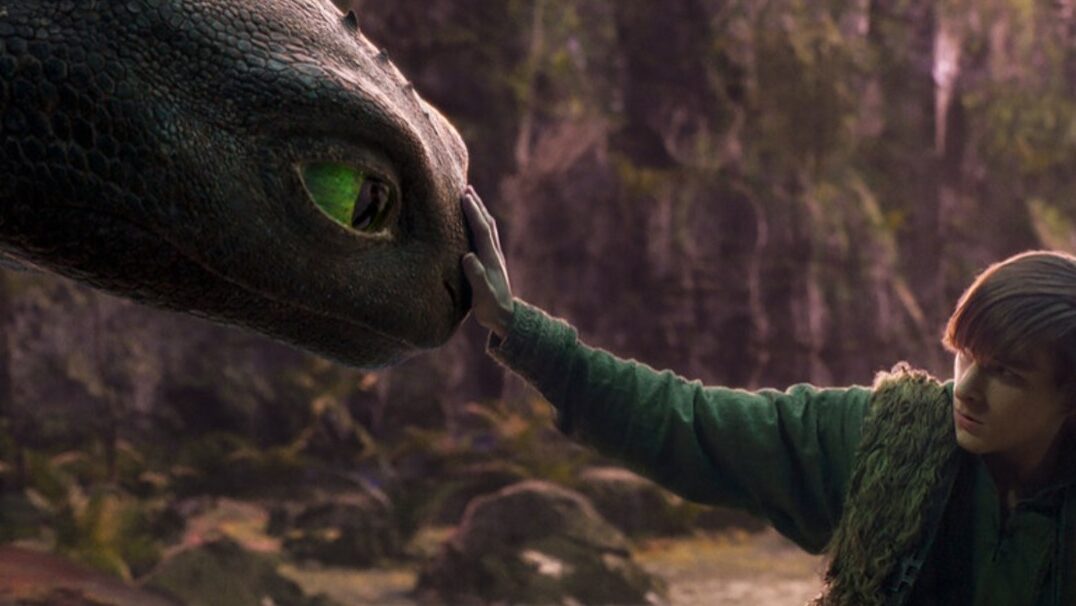
Just like in the animated film, Stoick is physically and emotionally the exact opposite of his short, scrawny, stubborn teenage son Hiccup, now played by up-and-comer Mason Thames. Although he doesn’t as expertly capture the awkwardness Jay Baruchel captured using just his voice, Thames effectively conveys his character’s sense of otherness from the Viking world. Apart from being physically weaker and having a more logical, less reactive mind, he’s more likely to be emotionally vulnerable. This is most evident in scenes between him and the dragon Toothless, who, despite his name, has retractable teeth; their transition from sworn enemies to best friends was in 2010 and remains now beautiful to behold. You see the same kind of bond between people and their pets, in both real life and the movies.
Speaking of Toothless – who, needless to say, remains a CG creation, as do all the dragon characters – DeBlois was wise to keep his overall look virtually identical to that of the animated film. The only minor difference is the rendering of his skin, which is just a little bit rougher, more believably conveying the wear and tear of battle and exposure to the elements. All the other dragons were noticeably less cartoonish in their designs, likely to add some degree of realism to mythical animals. I greatly appreciated DeBlois’ decision to not alter or eliminate the dragon mannerisms that were obviously inspired by cats. It’s impossible to miss in both versions of the film: The way they curl up when relaxing, their full-bodied reactions to chin scratches, and of course, the playfulness triggered by a spot of light on the ground.
I’ll end this review with a brief analysis of the special effects and the score, both admittedly superficial but important contributions nonetheless. The blending of computer generated imagery, the human actors, and the practical sets is seamless, especially in scenes where Hiccup rides on Toothless’ back and takes a thrilling, majestic flight over, around, and through the beautiful craggy peaks of Berk, the Viking’s island home. It’s also during these scenes that we hear the full grandeur of John Powell’s score. Powell also scored the animated film, which was grand but not necessarily epic. For this version, “epic” is the right word; the orchestrations have been beefed up to levels of bombast approaching Mahler. It’s nothing short of rousing. As for How to Train Your Dragon as a whole, it’s just as fun, exciting, and touching as the 2010 film – a guaranteed good time for the whole family.